Personalized!
A Powerful, Classy, and Creative way
to be joined at the hip with your favorite team
(And of course the uniforms print
will never go “out of Fashion” because a team’s uniforms are forever.)
You
can hang it, lean it, or let it lay flat.
Framed Version 3
Personalized
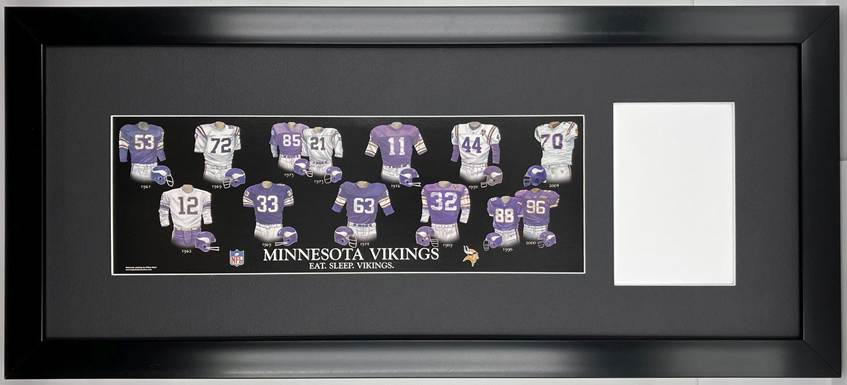
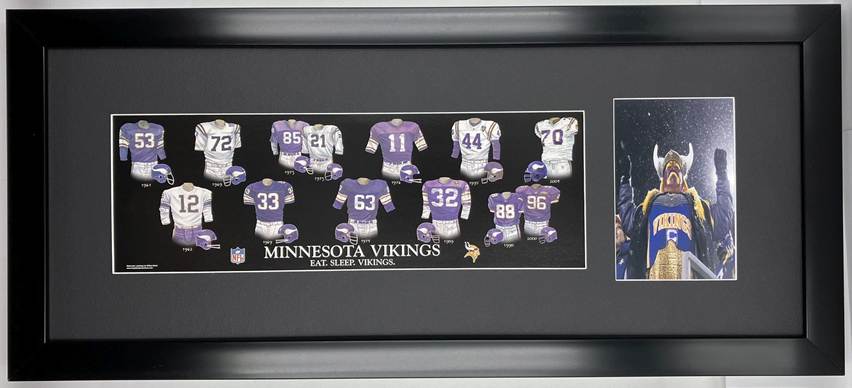
Framed Evolution History Minnesota Vikings Uniform Print with Your Photo: Framed with our classic, smooth black frame
with glass cover, it measures 11 3/4 inches high x 26 1/4 inches long. The cost for this custom picture is only $79 and there is a one-time $6 discount shipping cost regardless of how many you
order!
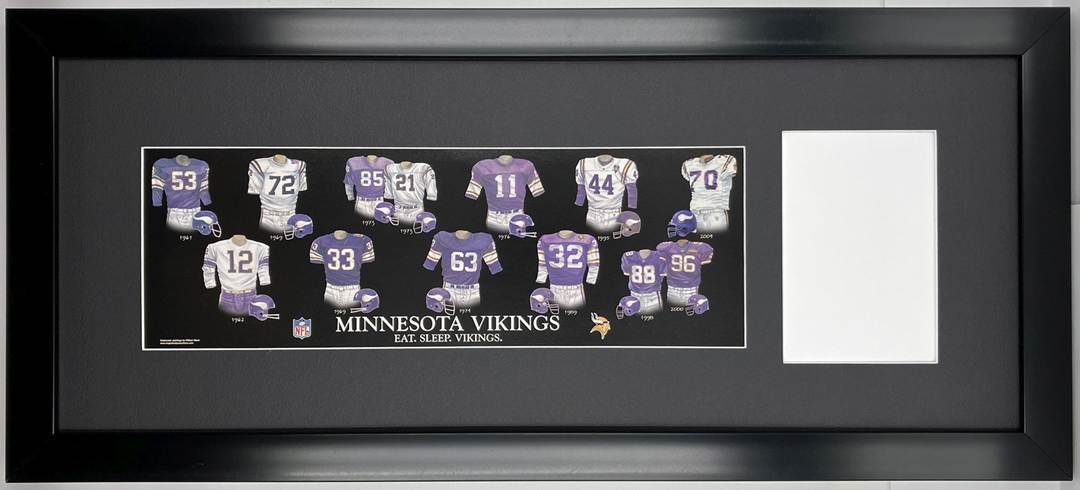
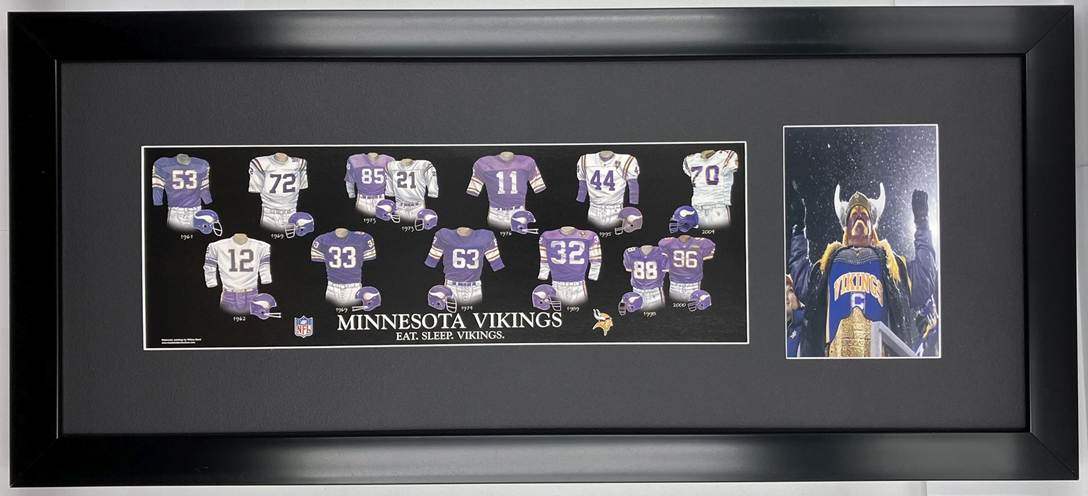
Just
add your standard 4 inch x 6 inch photo – whether it’s you in your team jersey,
or team memorabilia or something very creative, your photo possibilities are
endless because you’re only limited by your imagination.
And
you can change your photo as many times as you like!
Here are the easy steps to add your photo:
1. Use a standard 6 inch x 4 inch
photo. Keep in mind the mat will slightly overlap the photo 1/8 inch
on all four sides.
2. Turn the framed picture on its
back and bend up all the flexible tabs used to secure the picture.
3. Remove the white backing.
4. Place your photo over the mat
opening. We have marked guide lines to help you position the photo
perfectly.
5. Secure your photo on all four
sides with strips of the quality Artist’s Tape we have provided.
6. Put back the white backing and
bend back a few of the flexible tabs.
7. Look at the picture to make
sure it looks great. Then bend back the rest of the flexible tabs to
secure your framed picture. You’re Done!
We will of course include a card listing the above
steps with your order. Keep in mind you can
change your
photo as many times as you like!
And if you ever need more tape, just email us and we’ll mail you more
tape at no charge. Our email is listed
on the card.
You can also view our
how-to-do video for our “Team Up With” personalized picture (This how-to-do
video applies to all our personalized framed pictures) here:
Or you can download
our how-to-do video.
Ordering Info:
Or
(You don’t pay Sales Tax when you order from our Shopping Page.)
Click here to return to List of Teams and
Leagues
***************************************
The Minnesota Vikings: “Eat, Sleep,
Vikings,”
The Greatest-Scapes is an
accredited business of the Better Business Bureau. We have been a member of the Better Business
Bureau since 1986—and we have an A+ rating.
For more detailed
information about The Greatest-Scapes, please click the BBB Logo at left.
Thank you

E-mail: greatestscapes@hotmail.com
Click here to return to List of Teams and
Leagues
***************************************
Here is the history of the Vikings’ Uniforms …
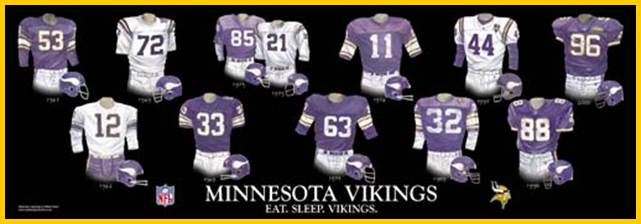
#1.
1961 The beginning of Minnesota’s NFL history is quite intriguing, but
to understand it you need to know a bit about the “American Football League”.
The American Football League (AFL)
began in 1960 as an 8 team rival league to the NFL. Both leagues competed head
to head for players, fans and broadcast revenue. This was the way it was from
1960 to 1965 - two separate leagues, two separate champions, although few
people would have honestly believed that the AFL champion could have beaten the
NFL champs. Then in 1965 the two leagues agreed to merge. It was decided that
beginning in 1970 there would be only one league, the NFL. In the interim,
between 1966 and 1969, the AFL Champion would play the NFL Champion for the
“World Championship”. It was only after the first World Championship had been
played in 1966 that the name “Super Bowl” came into being.
That being said, let’s get back to
Minnesota in 1959, where the upstart AFL league, in preparation of its
inaugural season in 1960, awards Max Winter and Bill Boyer a franchise for a
team in Minneapolis. Then early in 1960, prior to the start of the AFL season,
the NFL offers the same group an NFL franchise – which they accept. Thus, the Minnesota
Vikings become the NFL’s 14th squad for the 1961 NFL season instead
of an AFL team for the 1960 season.
As the team’ first coach,
ex-player Norman Van Brocklin, who had just led the Philadelphia Eagles to the
1960 league championship and then retired – faced an uphill battle of creating
a viable, competitive football entity in the ‘Land of 10,000 Lakes’. Convinced
that ‘gifted’, New York Giants’ passer George Shaw could be their quarterback
of the future, the Vikings traded for the quarterback – in turn giving up a 1st
round draft pick. Unfortunately, or fortunately – depending how you look at
things, Shaw was injured in the first quarter of the Vikings’ opening game.
Young understudy Fran Tarkenton took over the helm and helped the Vikings beat
the Chicago Bears 37-13 for one of the most impressive debuts in NFL history.
Unfortunately, the rest of the season would not be as rosy as the Vikings would
eventually finish 3-11. Tarkenton would, however, go on to lead the Minnesota
offence between the years 61-66 & 72-78 and in the process become one of
the NFL’s greatest passers.
The ’61 HOME uniform showcased
here, as worn by Tarkenton and Rip Hawkins, consists of a simple, yet elegant
color schematic and logo design that will go relatively unchanged over the
course of the next 40 years!
Of note: Bert Rose, the Vikings’
first general manager, selected the Vikings name because so many Minnesotans
can trace their heritage to Scandinavia.
#2.
1962 Another troubled year for Minnesota as they go 2-11-1. The
opposition, although usually victorious after a clash with the Vikings, rarely
got excited when faced with the task of playing them. Minnesota’s belligerent
playing style often left opponents injured, or very tender weeks later. At least this was a small
consolation for fans, who had to endure some of the coldest weather imaginable
while watching games from frigid Metropolitan Stadium.
The ’62 ROAD jersey shown here,
almost an exact inverse of the 1961 home jersey showcases purple numbers with
yellow trim. What seems to be missing from the dark, home version is the thin,
yellow trim around the sleeve striping – in this white jersey the sleeve
stripes are simply purple on white.
#3.
1969 In 1967, General Manager Jim Finks brought Harry P. Grant (aka Bud
Grant) to Minnesota Grant brought with him a slew of Grey Cup championships
from his days of coaching the Canadian Football League Winnipeg Blue Bombers,
and a stoic sideline personality. Originally, the Vikings wanted Grant to be
their inaugural skipper back in ’61, but were turned down at the time. Now they
finally had their man.
With Grant’s help, the mediocre
Vikings of the early to mid-60’s quickly turned into a team to be reckoned
with. In 1968, the Vikings had their first winning season as they went 8-6, and
made it to the Western Conference Championship. This 1968 title would be the
first of 10 divisional crowns the Vikings would see over the next 11 years!
In 1969, Grant’s Vikings won all
but two games during the regular season, going a league best 12-2. They went on
to beat the Rams in come from behind fashion 23-20 in the NFL Western
Conference Championship, then shut down the Browns 27-7 in the NFL Championship
game.
As mentioned in the 1961 jersey history
section, in 1965 the AFL and the NFL agreed to merge. It was decided that
beginning in 1970 there would be only one league, the NFL. In the interim,
between 1966 and 1969, the AFL Champion would play the NFL Champion for the
“World Championship”. It was only after the first World Championship had been
played in 1966 that the name “Super Bowl” came into being.
Thus it was that in 1969 the
Vikings won the NFL Championship, but still had to play the AFL Champs in Super
Bowl IV. In their first Super Bowl appearance, things didn’t go the Vike’s way
as the Kansas City Chiefs beat the Vikings 23-7 at Tulane Stadium in New
Orleans.
This 1969 white ROAD jersey strays
a bit from the 1962 jersey design. First, the traditional sleeve striping has
been moved much higher onto the shoulders – giving it a more vertical look.
Second, the yellow trim typically surrounding the chest & sleeve numbers
has been removed. Third, the team is now wearing white pants, rather than
purple. Note the patch on the left shoulder – commemorating the NFL’ 50th
anniversary. All NFL teams wore this patch for the ’69 season.
Of note: In our research we
discovered that the Vikings actually wore two different style road white
jerseys in 1969. We have chosen to show this one because they wore it in the
Super Bowl. The other white jersey had the NFL 50 patch on the sleeve, below
the uniform number.
Speaking of Bud Grant, from his
first year in 1967 to 1978, the Vikings won 11 division titles in 14 seasons.
They won the NFL championship in 1969 and NFC titles in 1973, 1974 and 1976.
Grant retired in 1983 but came back for one year in 1985. He finished with an
all-time 168-108-5 record, making him the eighth-winningest NFL coach ever.
#4.
1969 The ’69 purple HOME uniform showcased here, though almost identical
to the inaugural version of 1961, was not the only HOME sweater worn for this
season. The Vikings wore another HOME jersey in ’69 – a simpler, more basic
jersey. Just imagine the traditional Vikings’ purple sweater MINUS the sleeve
striping, and yellow trim around the numbers. We chose to show this jersey
because they seemed to wear it in their home playoff games.
Note the NFL patch on the left
shoulder of the jersey. This patch, worn to commemorate the NFL’s 50th
anniversary, was worn by all teams in ’69. Of special note, the NFL patch was
also on the ‘alternate’ jersey mentioned above – but its location was not on
the left shoulder, it was one the lower left sleeve directly below the uniform
numbers.
#5.
1973 Fran Tarkenton returned to the Vikings in ’72 after having spent 5
seasons with the NY Giants, and joined an already lethal team whose defensive
line was known as the ‘Purple People Eaters’ because of its toughness and
ability to devour opposing quarterbacks.
Though the ’72 team featured Carl
Eller, Alan Page, Jim Marshall and Gary Larsen – the Purple People Eaters - the
Vikings still only fared 7-7 in the regular season. The 1973 season, however,
was a different story! The Vikings lost only 2 games in the regular season as
they went 12-2. Then in the playoffs they beat the Redskins 27-20 and the
Cowboys right in Dallas 27-10, thus advancing to the Super Bowl for the 2nd
time in 4 years.
But once again, they came up short
in the Super Bowl and the powerful Dolphins won Super Bowl VIII 24-7.
This purple HOME jersey (the
‘alternate’ purple home jersey discussed in the 1969 purple painting) is a
different take from the traditional Vikings’ home uniforms. Gone are the sleeve
stripes and yellow trim around the numbers – leaving basic, white numbers on a
plain, purple jersey. The belt color has been switched over to purple from
white.
The white ROAD uniform is almost
identical to the ’69 version – with the exception that this belt is now purple
too.
#6.
1974 Another tale of ‘always a brides’ maid…never a bride’! The Vikings
win the NFC Central yet again, this time with a 10-4 record, then take the
Divisional Playoff and NFC Championship games 30-14 over the St. Louis
Cardinals and 14-10 over the Rams, only to lose Super Bowl IX at Tulane Stadium
in New Orleans to the Pittsburgh Steelers 16-6. This is the Vikings 3rd
Super Bowl appearance, and third loss, in 6 years.
This ’74 HOME jersey sees the
return of the arm striping – this time it’s purple and white stripes bordered
by yellow trim. The uniform numbers, however, are still simple and white with
no trim.
#7.
1976 It’s déjà vu all over again…
The Vikings dominate in the
regular season – going 11-2-1. They then capture the NFC Championship by beating
the Redskins 35-20 and the LA Rams 24-13. And they then advance to Super Bowl
XI, only to lose for the 4th time in 8 seasons – this time to the
Oakland Raiders 32-14, in front of over 100,000 people at the Rose Bowl in
Pasadena.
Look closely at the ’76 HOME
jersey, and you’ll see the ‘mesh’ design used by so many teams in this era. As
mentioned earlier, the tale of the Vikings jerseys is that they have been
remarkable consistent over the franchise’s 40+ years.
Of note: Let’s pay tribute to the
Vikings from the late 60’s to the late 70’s – during the 11 year period 1968 –
1976, the Vikings went a remarkable 90-35-1 in regular season play. This is a
mark perhaps unequalled by any other team over a 9 year period.
#8.
1989 The Vikings have put their hopes on running back Herschel Walker,
and pull a monstrous trade with the Dallas Cowboys to acquire this skilled
back. Joining Walker on the offense are such notables as wide receiver Anthony
Carter, eventual pro-bowler Randall McDaniel and quarterback Wade Wilson. The
‘Vikes’ go 10-6 and make the playoffs, but are ousted 41-13 in their first
playoff game by the San Francisco 49ers.
Look very carefully at the ’89
HOME jersey shown here. The jersey is actually made from two different fabrics,
each a different shade of purple! The sleeves and shoulders are a solid
material and lighter shade of purple, while the body of the jersey is a ‘mesh’
design and is slightly darker in color!
Notice also that by this time the
team has reverted back to a white belt. Also note the special patch on the left
shoulder. The Viking Norseman is sandwiched by the following: above him – the
words ‘20th anniversary 1969 NFL Champions’ and below him – the
phrase ’40 for 60’. The patch commemorates the Vikings’ winning their first NFL
Championship in 1969…but wait a minute…the Vikings have never won the Super
Bowl!?! The answer to the riddle –
before the AFL & NFL leagues merged in 1970, the champions from both
leagues faced off in the ‘Super Bowl’ for the years 1966-69 inclusive. Thus, in
’69, the Vikings were indeed the NFL Champions, and they played the AFL
Champion Kansas City Chiefs in the Super Bowl, losing 23-7 at Tulane Stadium in
New Orleans.
Of note: Three years earlier, in
1986, Fran Tarkenton became the first Viking to be elected to the Pro Football
Hall of Fame.
Note also: In 1982 the Vikings
moved into the Hubert H. Humphrey Metrodome, leaving forever the frigid but
friendly confines of Metropolitan Stadium.
#9.
1995 We’re now moving into Minnesota’s ‘high-octane’ offensive years!
Under coach Dennis Green’s guidance, and with weapons such as QB Brad Johnson,
wide receiver Chris Carter and running back Robert Smith, the Vikings’ road to
respectability has begun – they go 8-8 in 1995 in an extremely competitive NFC
Central Division. It will still be a couple of years before these components
become a ‘well-oiled machine’ – but the parts are there!
One note about the uniform: If you
look closely at almost all NFL uniforms worn from 1991 on, you’ll note a small
NFL shield patch on the jersey’s neckline. Most NFL uniforms added the NFL logo
patch to the neck, and to the upper left thigh of the pants, beginning in 1991.
The only major exception to this practice was in 1994 when the teams wore their
throwback uniforms – in these throwback cases, teams did not wear the NFL
shield patch.
The 1995 ROAD jersey showcased
here features some interesting changes from previous years. Firstly, there’s
the NFL shield/patch as mentioned above. Secondly, the sweater’s sleeves are
elasticized to prevent defenders from grabbing hold of baggy, excess material,
and using it to slow down their opponents. Next is the fact that the
conventional purple and yellow striping is now almost completely vertical. And
finally, a commemorative patch celebrating the Vikings’ 35th
anniversary can be found on the left shoulder. It features the ‘Viking’ head;
the number ‘35’ for the team’s 35th anniversary; and the dates
‘1961’ & ‘1995’ sandwiching a large purple ‘V’.
Of note: In 1991, the Vikings went
8-8 and missed the playoffs. Of all the rotten luck, given that Super Bowl XXVI
was held at the Hubert H. Humprey Metrodome (which opened in 1982).
#10.
1998 Randall Cunningham is throwing bombs,Randy Moss is making acrobatic
receptions, .and Chris Carter and Randy Moss keep making TD catch after TD
catch. The Vikings’ firepower and offensive attack is unrelentless, translating
into a 15-1 regular season record (their best record ever) & post-season
dates for the boys in purple. Actually, the Vikings’ 1998 playoff appearance
means they have made the post season 6 times in the last 7 seasons.
In round 1 of the playoffs, the Vikings squared off against the Cardinals
and left them reeling - Vikings 41 - Cardinals 21.
In the NFC conference final, the Vikings
were favored over the surprising Falcons. But in a topsy turvy, wildly exciting
game that went deep into overtime, the Falcons emerged on top 30 - 27 to end
the Vikings Super Bowl XXXIII aspirations.
This purple HOME jersey features
some terrific nuances: the sleeve striping has been simplified & condensed
– with narrower white & yellow stripes; the familiar yellow trim from past
jerseys has returned, and now “borders” all the uniform numbers; finally, the
Viking head, just as identifiable as the ‘horns’ logo, is now a patch on the
sleeves!
#11.
2000 The Vikings are preparing young Daunte Culpepper to lead this team
into the new millenium. A 6’5”, 260 pound quarterback that can throw, run, and
act as his own blocker!
This purple HOME jersey, as worn
by Culpepper, Randy Moss, Chris Carter & Robert Smith is almost identical
to the ’98 model – with a few exceptions. The NFL patch on the sweater’s
neckline is larger than in years past. You’ll also notice a large patch on the
left shoulder, close to the NFL shield, celebrating the Vikings’ 40th
anniversary. It reads: ‘Minnesota Vikings’ at the top, with the dates ‘1961’
& ‘2000’ sandwiching the legendary Viking head with the phrase ‘40th
anniversary’ at the bottom.
Happy anniversary, Vikings! May
your next 40 years bring you the Super Bowl trophies you’ve been missing!
Of note: Over the past 25 years,
the Minnesota Vikings have consistently been at or near the top of their
division (the NFC Central). During that 25 year period, only the Dallas Cowboys
have made more playoff appearances than the Vikings. Furthermore, only four
teams (Dallas, San Francisco, Pittsburgh, Denver) have played in more Super
Bowls than Minnesota, which has participated in four (Super Bowls IV, VIII, IX
and XI).