Personalized!
A Powerful, Classy, and Creative way
to be joined at the hip with your favorite team
(And of course the uniforms print
will never go “out of Fashion” because a team’s uniforms are forever.)
You
can hang it, lean it, or let it lay flat.
Framed Version 3
Personalized
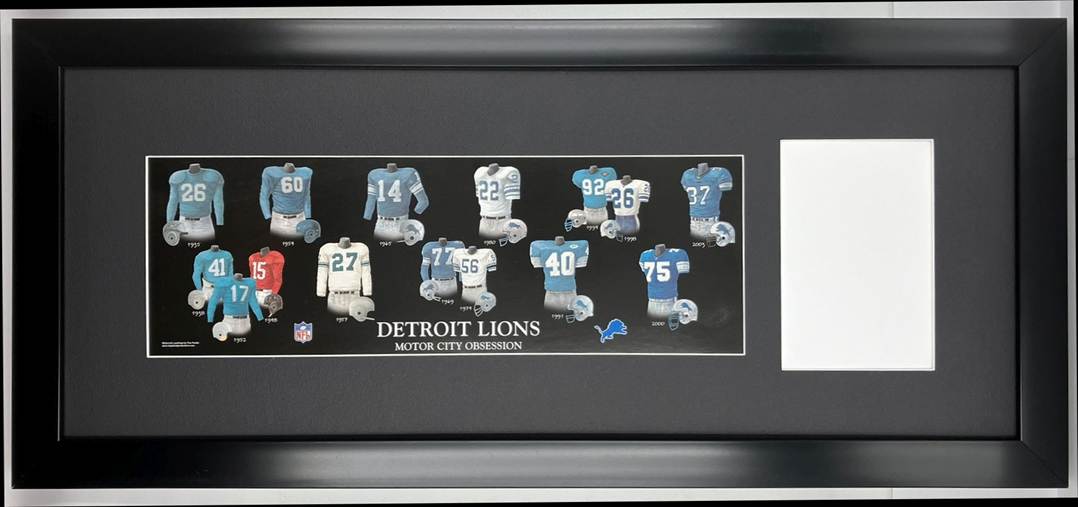
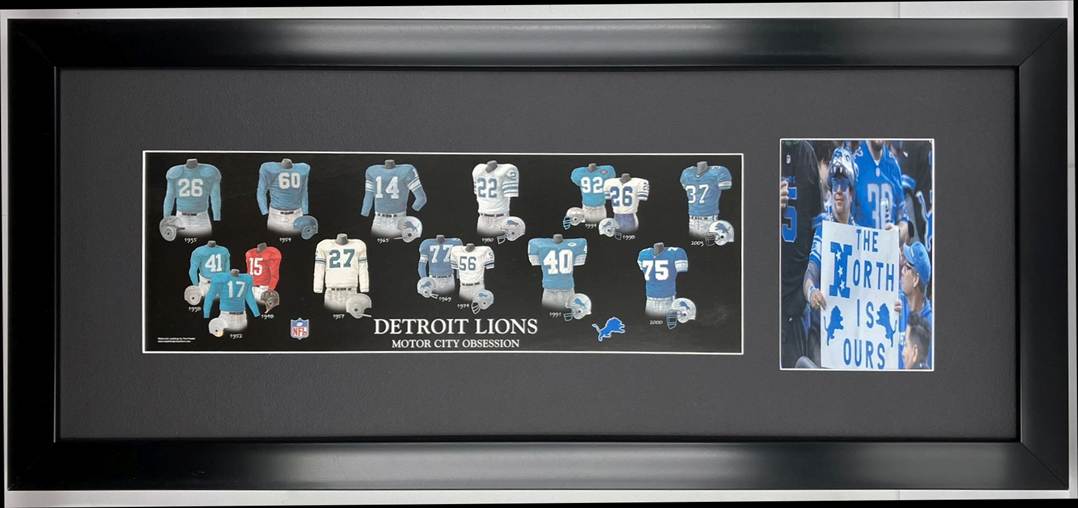
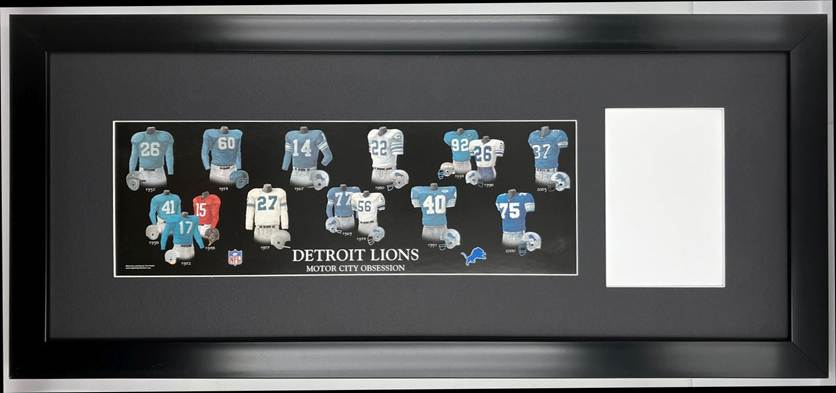
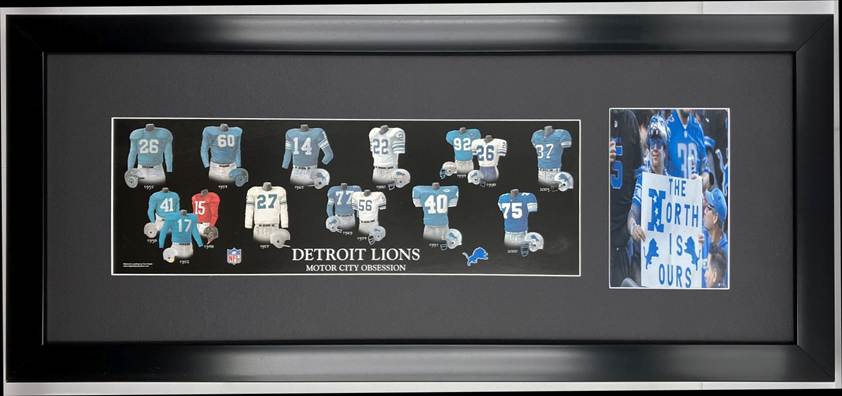
Framed Evolution History Green Bay Packers Uniform Print with Your Photo: Framed with our classic, smooth black frame
with glass cover, it measures 11 3/4 inches high x 26 1/4 inches long. The cost for this custom picture is only $79 and there is a one-time $6 discount shipping cost regardless of how many you
order!
Just
add your standard 4 inch x 6 inch photo – whether it’s you in your team jersey,
or team memorabilia or something very creative, your photo possibilities are
endless because you’re only limited by your imagination.
And
you can change your photo as many times as you like!
Here are the easy steps to add your photo:
1. Use a standard 6 inch x 4 inch
photo. Keep in mind the mat will slightly overlap the photo 1/8 inch
on all four sides.
2. Turn the framed picture on its
back and bend up all the flexible tabs used to secure the picture.
3. Remove the white backing.
4. Place your photo over the mat
opening. We have marked guide lines to help you position the photo
perfectly.
5. Secure your photo on all four
sides with strips of the quality Artist’s Tape we have provided.
6. Put back the white backing and
bend back a few of the flexible tabs.
7. Look at the picture to make
sure it looks great. Then bend back the rest of the flexible tabs to
secure your framed picture. You’re Done!
We will of course include a card listing the above
steps with your order. Keep in mind you can
change your
photo as many times as you like!
And if you ever need more tape, just email us and we’ll mail you more
tape at no charge. Our email is listed
on the card.
You can also view our
how-to-do video for our “Team Up With” personalized picture (This how-to-do
video applies to all our personalized framed pictures) here:
Or you can download
our how-to-do video.
Ordering Info:
Or
(You don’t pay Sales Tax when you order from our Shopping Page.)
Click here to return to List of Teams and
Leagues
***************************************
The Detroit Lions: “Motor City
Obsession”
The Greatest-Scapes is an
accredited business of the Better Business Bureau. We have been a member of the Better Business
Bureau since 1986—and we have an A+ rating.
For more detailed
information about The Greatest-Scapes, please click the BBB Logo at left.
Thank you

E-mail: greatestscapes@hotmail.com
Click here to return to List of Teams and
Leagues
***************************************
Here is the history of the Lions’ Uniforms …
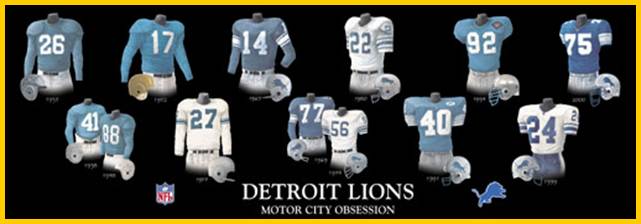
#1.
1935
In the 1920's, three different
attempts to establish a pro football team in Detroit failed: the Detroit
Heralds in the American Professional Football Association (later named the NFL)
lasted only 4 games into the 1920 season but came back for 7 more games in
1921; the Detroit Panthers in the NFL in 1925 and 1926; and the Detroit
Wolverines in the NFL in 1928.
But in 1934, Detroit radio
executive George A. Richards purchased the Portsmouth, Ohio Spartans for the
then remarkable sum of $8,000 and moved the franchise to the Motor City, where
it remains to this day – fourth time lucky!
The Portsmouth Spartans joined the
NFL in 1930. In 1932, they played in one of history's most pivotal games, a
hastily-scheduled NFL championship game against the Chicago Bears. The game was
won by the Bears 9-0 in the first ever INDOOR pro football game, played
December 18, 1932 in Chicago Stadium because of inclement weather. By winning,
the Bears ensured themselves of the ‘World’s Champions’ title in what was the
first ever NFL playoff game. What made the game even more important, however,
is the fact that the NFL changed as a result of the game: the decision was made
to divide the league into two divisions, and an annual NFL title showdown was
established between the winners of each division.
Unlike the three earlier Detroit
teams, the 1935 Lions were loaded with some of the finest players of the day.
The team leader was Dutch Clark, a triple-threat star (and the last NFL drop
kicker) who became a charter member of the Hall of Fame.
After going 7-3-2 and winning the
4 team Western Division in just their second year in Detroit, the Lions won the
NFL championship in 1935 beating the New York Giants 26 – 7 in front of 15,000
fans at the University of Detroit Stadium. Those early successes (they finished
10-3 in their first year in Detroit) firmly established pro football in Detroit
and for more almost 70 years the sport has been an integral part of the
Michigan sports scene.
The Lions name was simply chosen
by team owner George Richards. “The lion is monarch of the jungle,” a team
spokesperson said, “and we hope to be the monarch of the league.” Our guess is
the fact that the long established baseball Tigers also had some bearing on the
name choice, but it’s just a hunch.
The 1935 uniform consisted of a
simple blue jersey with white numbers and white pants. The helmet, on the other
hand, was silver.
#2A.
1938 In 1938 the Lions moved from the University of Detroit Stadium to
Briggs Field, home of the Detroit Tigers baseball team, where they stayed for
37 years (Briggs Field was later named Tiger Stadium, and the Tigers stayed
there until the end of the 1999 baseball season, another 62 seasons).
The Lions continued their winning
ways, going 8-4 in 1936 and 7-4 in 1937, but had the misfortune of playing in
the same division as the Packers and the Bears. And 1938 was more of the same
as the Lions went 7-4 but finished a game behind the 8-3 Packers.
An interesting sign of the times
was the fact that Bill Shepherd, the Lions great fullback, rushed for 455 yards
in 11 games and finished 3rd in total rushing yards, behind league
leader Byron “Whizzer” White of Pittsburgh who amassed 567 yards (this is the
same Whizzer White who would go on to greater fame as a Supreme Court Judge).
This jersey is once again a simple
blue top with white numbers, and the helmet is silver. The blue of the jerseys
is sometimes referred to as a Hawaiian blue. Note the pant extensions designed
to protect the kidneys from side blows.
#2B.
1948 After enjoying a pretty successful first decade, the Lions took a
step backward in the 40’s, having just two winning seasons (1944 & 1945).
The 1945 Lions had a tough season, going 2 and 10, finishing in fifth (last)
place.
The only Lions to be among the
league leaders in any offensive category was halfback Bill Dudley, who scored 6
TD’s and booted 30 extra points and 5 field goals for 81 points scored.
The 1948 HOME jersey is once again
a simple blue top with white numbers. The helmet is a lighter silver color.
Almost all players in this era played without face masks, and many would
continue going mask-less well into the 50’s, some as late as 1960.
#3.
1952 The 40’s behind them, the Lions practically owned the 50’s.
It was the 50’s that saw the Lions
enjoy their finest years ever, as they won four division titles and three
league championships (1952, 1953 and 1957). Among the stars on those teams were
such future Hall of Famers as quarterback Bobby Layne (1950-57), running back
Doak Walker (191950-55), tackle-guard Lou Creekmur (1950-59) and defensive back
Jack Christiansen (1951-58).
The Lions tied the LA Rams for
first in the 6 team National Conference with identical 9-3 records, and thus
had to play a one game playoff against the Rams. For reasons that are slightly
unclear to me (perhaps because they won both regular season games vs the Rams),
the playoff game was played in Detroit at Briggs Stadium. In front of 47,000+
fans, the Lions handed the Rams a 31-21 loss to advance to the NFL Championship
game. This was the 5th such playoff game needed to decide a division
winner since the NFL began two division play in 1933 (1941, 1943, 1947, 1950
and 1952).
In the NFL Championship, the Lions
took on the powerful and favorite Cleveland Browns in front of 50,000+ at
Municipal Stadium in Cleveland. In a
game that was statistically dominated by the Browns (the Browns had 22 1st
downs to Detroit’s 10), the Lions came out on top 17-7 on the strength of their
great defense, Bobby Layne’s 7 for 10 passing and Doak Walker’s 67 yard
touchdown run.
In 1952 the Lions’ HOME jersey was
again a Hawaiian blue with white numbers. But interestingly, for what we
believe to be only one season, the helmet has changed to a gold color.
Before we head to 1957, lets touch
on the Lions’ championship season in 1953 as well, when they went 10-2 to win
the West outright. They faced the Browns yet again, only this time the game was
in Detroit. In a hard fought game, the Lions came from behind in the 4th
to edge the Browns 17-16. This time, however, the Lions held the edge in play
(18 1st downs to Cleveland’s 11).
And in 1954, the same two teams
went at it again. Finally Cleveland came out on top, winning handily in
Cleveland by a 56-10 count in a game that was remarkably close statistically
except for the 6 interceptions thrown by Bobby Layne.
#4.
1957 From 1950 to 1957 the Lions had only one losing season (1955), and during
this stretch they went 61-33-2. In fact, the Lions enjoyed their finest years
in the 1950's, when they won four division titles and three league
championships (1952, 1953 and 1957).
This is the first ROAD white
jersey we have seen in the poster, and it features the addition of blue
stripes, and numbers, on the sleeves. After a brief hiatus in 1952 when the
helmet was silver, and perhaps 1955-ish when the helmet was blue for one
season, the helmet is once again silver. Note the addition of a face mask on
this helmet (by now the majority of players wore face masks, although Bobby
Layne would play without one right into the 1960 season).
In 1957 the Lions tied the San
Francisco 49ers with similar 8-4 records, and this time the Lions headed west
to break the tie (as in 1952, I’m not sure what the criteria was to decide
where the playoff game was played – this year each team won their home game
against the other). After being down 27-7 in the 3rd quarter, the
Lions roared back to steal the game 31-27 over the 49ers in a game played in
San Francisco at Kezar Stadium.
And who do you think the Lions
faced in the NFL Championship? Of course, the Browns. And turnabout being fair
play, the Lions slammed the Browns 59 - 14 in a game played in Detroit at
Briggs Stadium before 55,000+ screaming fans. The hero this time out was QB
Kyle Rote, who (with a little help from halfback Howard Hopalong Cassady)
completed 13 of 22 passes for 296 yards and no interceptions.
#5.
1965 As the NFL and AFL are locked in a battle for the hearts and minds
of football fans, the Lions are purchased for $4,500,000 in 1964 by William
Clay Ford.
Meanwhile, on the field the first
half of the 60’s are pretty kind to the Lions as they have winning seasons 4 of
the 1st 5 years. In 1965, however, the Lions fall below .500 with a
6-7-1 record, good only for 6th in the 7 team Western Conference.
One star is kickoff return
specialist Tommy Watkins, who gains 584
yards via kickoff returns. But perhaps the most amazing stat of the season is
the 1544 yards gained by Cleveland running back Jim Brown in his 9th
and last season in the NFL – in second place was Gayle Sayers of the Bears with
867 yards.
This is once again a blue jersey
with white numbers on the front and on the sleeves above the triple white
stripes. The blue in this jersey is slightly toned down from the brighter blues
of the 40’s and 50’s. Note also that this is the first time we have seen the
Lions logo on the helmet although it made its first appearance several years
earlier.
#6A.
1969 The period of time between 1966 and 1969 warrants a bit of
explanation. The 8 team AFL began in 1960 as a rival league to the NFL - both
leagues competed head to head for players, fans and TV revenue. And thus it was
for 5 years - two separate leagues, two separate champions (although few people
would have honestly believed that the AFL champion could have beaten the NFL
champs). Then in 1965 the two leagues agreed to merge. It was decided that
beginning in 1970 there would be only one league, the NFL, and that between
1966 and 1969 the AFL Champion would play the NFL Champion for the “World
Championship”. It was only after the first World Championship had been played
in 1966 that the name “Super Bowl” came into being.
Thus the 1966 season saw the first
meeting of the AFL and NFL champions, with the NFL Champion Green Bay Packers
humbling the AFL’s KC Chiefs 33-10. (Even though the game was played in 1967,
most football historians refer to this as the 1966 Super Bowl because it was
the culmination of the 1966 season.) The NFL superiority was on display again
in 1967, when the NFL’s Packers pounded the AFL’s Raiders 33-14. Then came 1968 and the stunning upset - the
AFL’s NY Jets shocked the football world by beating the NFL’s heavily favored
Baltimore Colts 16-7.
After that great buildup, I wish
we could report that the Lions took on the AFL’s best in 1969, but the truth is
that the Lions finished a very respectable 9-4-1, but well behind the Vikings’
12-2 record and therefore out of the playoffs.
On this blue jersey we see the
patch on the left shoulder marking the NFL’s 50th anniversary. This
patch was worn by all 16 NFL teams in 1969, but not by any AFL squads. When I
see this jersey I can just about see the great and charismatic Alex Karras, the
6’ 2” 250 lb. defensive tackle for the Lions roaming the field in search of
prey. Karras played 12 straight years for the Lions, never missing a game from
1958 until his final year in 1970.
#6B.
1974 The Lions have been looking for their fourth NFL title for almost
20 years (they won it all in 1952, 1953 and 1957), but the 70’s won’t be their
decade. While they had great players in the 1970’s - such as Joe Schmidt, Yale
Lary, Lem Barney and Dick "Night Train" Lane, each of whom has been
elected to the Hall of Fame—the best the Lions of the 70’s could do was slip
into the playoffs once, and even then it was as a wildcard team in 1970.
In 1975, the Lions left Tiger
Stadium (where they had played since 1938) for a new home, the 80,494-seat
Pontiac Silverdome, a then state-of-the-art facility in the Detroit suburb of
Pontiac, MI.
On this white ROAD jersey we see
short sleeves for the first time on a Lions jersey as well as an attractive
silver outline around the numbers – now this is a good looking uniform. The lion
on the helmet now has also has a white outline around it.
#7.
1980 As much as the 1970’s weren’t particularly kind to the Lions, the
1980’s may have been worse. The Lions will finish above .500 only twice, and make
the playoffs only once, in 1983. They exited just as quickly, although the 1983
season is memorable because the Lions are paced by superstar running back Billy
Sims, who played just 5 short years (1980-84) before retiring.
As for 1980, the year of this
jersey, the Lions finished 9-7 and Billy Sims gained a very respectable 1303
yards – 5th in the league. This white ROAD jersey hasn’t changed
much over the years, the only minor change is perhaps the width of the white
area between the sleeve stripes.
#8.
1991 The Lions returned to respectability in the topsy turvy 90’s. Over
the 10 year period, the Lions almost establish a pattern of finishing .500 or
better one year, then below .500 the next. They end the decade with five
winning seasons, one .500 season and 4 losing seasons.
The great news is that the Lions
won division titles in 1991 and 1993, and in 1991, they won their first playoff
game since1957 (they only made it to the playoffs 3 times since 1957 and lost
all 3 in the first round).
In 1991, however, the Lions finish
a terrific 12-4 under coach Wayne Fontes, and win the NFC Central. After
clobbering the Cowboys 38-6 at the Silverdome, the Lions advanced to the NFC
championship game for the first time in franchise history. Alas, they came up
against the inspired Redskins, who cruised to a 41-10 win en route to their 3rd
Super Bowl Championship in 9 years.
If you look closely at this
jersey, you will note a smaller patch of the NFL shield on the
jersey’s neckline. Most NFL uniforms added the NFL logo patch to the neck and
upper left thigh of the pants beginning in 1991 - an exception being in 1994
when teams occasionally wore "throwback" uniforms celebrating the
NFL's 75th anniversary.
The “JRT” patch on the left side
is in honor of Russ Thomas, the team’s much loved General Manager who passed
away suddenly before the season began.
#9.
1994 After falling to a 5-11 record in 1992, the Lions came back in 1993
with a 10-6 record to capture their 2nd NFC Central Championship in
3 years.
In 1994, the Lions finished tied
for second in NFC Central with a 9-7 record. They would go to the playoffs only
to lose an wild NFC Wildcard game 28-24 in the 4th quarter to the
Green Bay Packers.
During this 1994 season, the NFL
and its franchises were showcasing ‘throwback’ jerseys, or replicas of older
uniforms to help commemorate the NFL’s 75th anniversary. The 75th
anniversary was also commemorated by the diamond patch on the upper left part
of the torso - this patch was worn on all 1994 jerseys whether they were "throwback"
jerseys or not. Every NFL team wore a throwback jersey for one or more games
during the 1994 season, and the Lions wore this one to celebrate their 1957
Championship season.
One note about the uniform: If you
look closely at almost all NFL uniforms worn from 1991 on, you’ll note a small
NFL shield patch on the jersey’s neckline. Most NFL uniforms added the NFL logo
patch to the neck, and to the upper left thigh of the pants, beginning in 1991.
The only major exception to this practice was in 1994 when the teams wore their
throwback uniforms – in these instances, as is the case here, most teams did
not wear the NFL shield patch.
Note also the Lions’ throwback
helmet – like it’s 1957 counterpart, there is no logo on this helmet – it’s
amazing how naked the helmets look without logos on them.
#10.
1999 Proving there is life after Barry Sanders, the Lions go a
respectable 8-8 on the season and sneak into the playoffs with a .500 record, a
rare occurrence in the NFL playoff structure. In the playoffs the Lions come up
short against the Redskins by a 27-13 score in DC.
This is a white jersey with blue
pants, the first time we’ve seen the Lions in blue pants. While this is a
departure, I’d say it’s a great look, one we hope the Lions will hang on to. The
helmet is traditional with the lion logo on it.
One note about the uniform: If you
look closely at almost all NFL uniforms worn from 1991 on, you’ll note a small
NFL shield patch on the jersey’s neckline. Most NFL uniforms added the NFL logo
patch to the neck, and to the upper left thigh of the pants, beginning in 1991.
The only major exception to this practice was in 1994 when the teams wore their
throwback uniforms – in these instances, most teams did not wear the NFL shield
patch.
#11.
2000 This blue jersey shows that the numbers have moved from sleeves to
the shoulders. The sleeve stripes are an attractive combination of silver and
white stripes. Note that the blue of the jersey has become a little bit deeper
blue than say 1991, although this may not be the official party line, the naked
eye usually doesn’t miss a trick. The helmet is still the traditional silver
and lion logo.
On the field the 2000 Lions went
9-7 but missed the playoffs by a single game. Statistically, the team is lead
by QB Charlie Batch, running back James Stewart and receiver Johnnie Morton.