Personalized!
A Powerful, Classy, and Creative way
to be joined at the hip with your favorite team
(And of course the uniforms print
will never go “out of Fashion” because a team’s uniforms are forever.)
You
can hang it, lean it, or let it lay flat.
Framed Version 3
Personalized
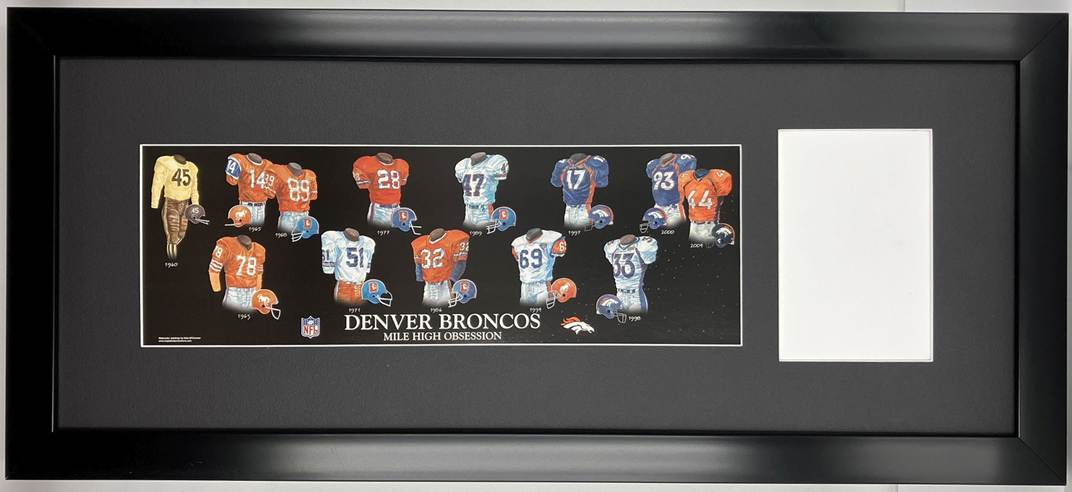
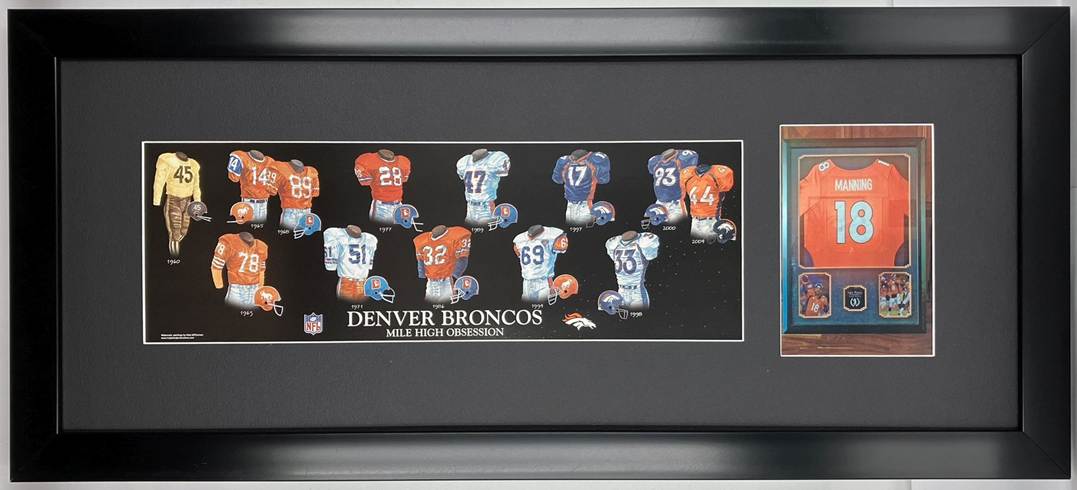
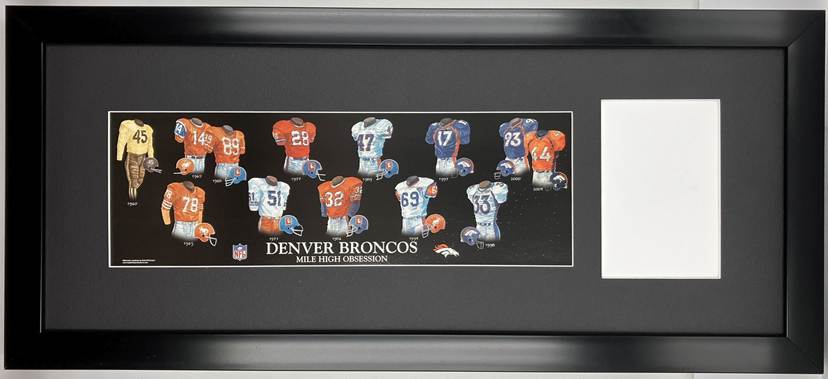
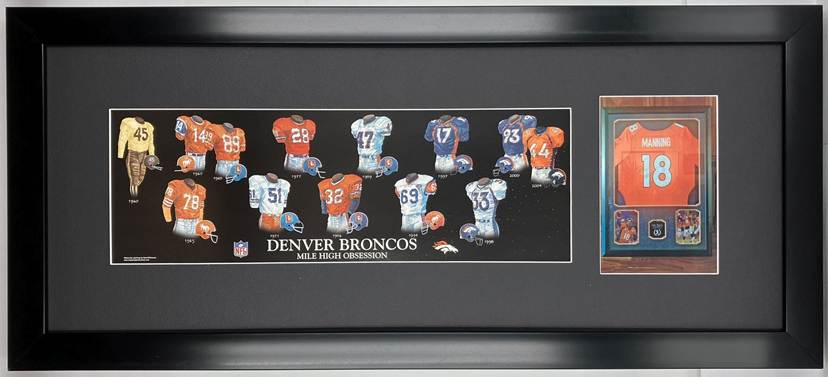
Framed Evolution History Denver Broncos Uniform Print with Your Photo: Framed with our classic, smooth black frame
with glass cover, it measures 11 3/4 inches high x 26 1/4 inches long. The cost for this custom picture is only $79 and there is a one-time $6 discount shipping cost regardless of how many you
order!
Just
add your standard 4 inch x 6 inch photo – whether it’s you in your team jersey,
or team memorabilia or something very creative, your photo possibilities are
endless because you’re only limited by your imagination.
And
you can change your photo as many times as you like!
Here are the easy steps to add your photo:
1. Use a standard 6 inch x 4 inch
photo. Keep in mind the mat will slightly overlap the photo 1/8 inch
on all four sides.
2. Turn the framed picture on its
back and bend up all the flexible tabs used to secure the picture.
3. Remove the white backing.
4. Place your photo over the mat
opening. We have marked guide lines to help you position the photo
perfectly.
5. Secure your photo on all four
sides with strips of the quality Artist’s Tape we have provided.
6. Put back the white backing and
bend back a few of the flexible tabs.
7. Look at the picture to make
sure it looks great. Then bend back the rest of the flexible tabs to
secure your framed picture. You’re Done!
We will of course include a card listing the above
steps with your order. Keep in mind you can
change your
photo as many times as you like!
And if you ever need more tape, just email us and we’ll mail you more
tape at no charge. Our email is listed
on the card.
You can also view our
how-to-do video for our “Team Up With” personalized picture (This how-to-do
video applies to all our personalized framed pictures) here:
Or you can download
our how-to-do video.
Ordering Info:
Or
(You don’t pay Sales Tax when you order from our Shopping Page.)
Click here to return to List of Teams and
Leagues
***************************************
The Denver Broncos: “Mile High
Obsession”
The Greatest-Scapes is an
accredited business of the Better Business Bureau. We have been a member of the Better Business
Bureau since 1986—and we have an A+ rating.
For more detailed
information about The Greatest-Scapes, please click the BBB Logo at left.
Thank you

E-mail: greatestscapes@hotmail.com
Click here to return to List of Teams and
Leagues
***************************************
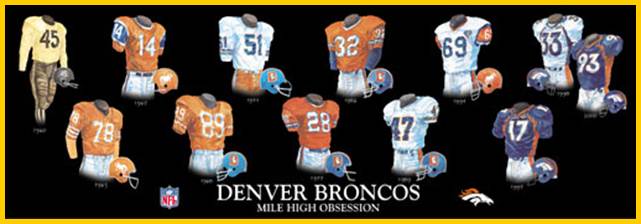
Here is the history of the Broncos’ Uniforms …
#1.
1960
One mile above sea level, the
Denver Broncos were created in 1960. Joining the AFL as charter members as
well, were the New York Titans (now Jets); Dallas Texans (now Kansas City
Chiefs); Los Angeles Chargers (now San Diego Chargers); Houston Oilers (now
Tennessee Titans); Boston Patriots (now New England Patriots); Buffalo Bills;
and Oakland Raiders.
The name Broncos’ was adopted
after a baseball team that had once played in Denver (Denver’s 1921 Midwest
Baseball League team was apparently also called the Broncos). The Broncos’,
outfitted in what most consider to be the ugliest uniforms of all time
(especially with the vertically-striped socks shown in this painting) ventured forth
into its first season of professional football. Despite losing its first 5
exhibition games, the team managed to become the first AFL club with a regular
season victory (a September 9, 1960 13-10 victory over the Boston Patriots).
This glimmer of hope would soon fade as the club finished 4-9-1 and thus began
13 straight years of sub .500 football. In fact, the 1960’s Broncos would
finish the decade with a frightening 39-97-4 record, the worst of any of the
original eight AFL teams.
We decided to showcase the ENTIRE
’60 uniform so football enthusiasts could see the striping pattern on the
socks. General Manager, Dean Griffing, bought the uniforms from the defunct
‘Copper Bowl’ which was held in Tucson, Arizona. After finishing the ’61 season
with a disappointing 3-11, the Broncos’ second head coach, Jack Faulkner, made
it a priority to gas these abominations! A public uniform burning session took
place, resulting in an interesting circumstance – there are now precious few
pictures of the uniforms still existing today, let alone actual jerseys and
socks.
#2.
1963
With the yellow & brown
uniforms now a bitter memory, Coach Faulkner went out, and purchased orange
uniforms which eventually lead to ‘orange mania’. Ironically, Faulkner was
under the impression the uniforms were going to be ‘burnt orange’, similar to
the Cleveland Browns. Instead, the manufacturer sent bright orange. This
familiar color would remain a Broncos staple, well into the 90’s! Note the
striping pattern on the ’63 jersey – three white stripes, and the ‘bucking
bronco’ logo on the helmet.
After posting a respectable 7-7
season record in 1962, the Broncos’ took a step backwards in 1963 recording the
first of two consecutive 2-11-1 seasons. Of note, both 1963 wins came at home
in Mile High Stadium.
#3.
1965
The ’65 jersey features some
interesting modifications: a thick, blue stripe has now been added to both
sleeves with the players’ number nestled inside the striping pattern. If you
look closely, you’ll also notice a thin, blue trim around the white numbers on
the front of the jersey, and the addition of a white collar.
An interesting note about 1965:
The AFL began in 1960 as an 8 team rival league to the NFL. Both leagues
competed head to head for players, fans and broadcast revenue. This was the way
it was from 1960 to 1965 - two separate leagues, two separate champions
(although few people would have honestly believed that the AFL champion could
have beaten the NFL champs). Then in 1965 the two leagues agreed to merge. It
was decided that beginning in 1970 there would be only one league, the NFL. In
the interim, between 1966 and 1969, the AFL Champion would play the NFL
Champion for the “World Championship”. It was only after the first World
Championship had been played in 1966 that the name “Super Bowl” came into
being. Thus the 1965 season was the last season there was an AFL Champion that
didn’t go on to compete against the NFL Champs but that really didn’t matter to
1965’s 4-10 Broncos who missed post-season play for the 6th straight
year.
Did you know? The Broncos came
within a whisker of leaving Denver. In 1965, several minority partners formed a
majority and voted to sell the Broncos to a group who wanted to move the team
to Atlanta. At the last minute, Gerald and Allan Phipps, who had been left out
of the voting block, bought the team. Excited fans showed their appreciation by
purchasing almost 23,000 season tickets, compared to fewer than 8,000 the year
before all this in spite of the team’s dismal record in their first 6 years of
existence.
With respect to the AFL-NFL
Championship game, here’s what happened between 1966 and 1969: The 1966 season
saw the first meeting of the AFL and NFL champions, with the NFL Champion Green
Bay Packers humbling the AFL’s KC Chiefs 33-10. (Even though the game was
played in 1967, most football historians refer to this as the 1966 Super Bowl
because it was the culmination of the 1966 season.) The NFL superiority was on
display again in 1967, when the NFL’s Packers pounded the AFL’s Raiders 33-14.
Then came 1968 and the stunning upset - the AFL’s NY Jets shocked the football
world by beating the NFL’s heavily favored Baltimore Colts 16-7.
Thus the stage was set for the Super
Bowl IV, the last meeting between the AFL and NFL Champions, and once again the
AFL triumphed, evening the series at two wins apiece, as the AFL’s Kansas City
Chiefs whacked the NFL’s Minnesota Vikings 23-7.
One final AFL-NFL note: In 1967
the Broncos did set one AFL-NFL record – they were the first AFL team to beat
an NFL team, beating the Detroit Lions, 13-7 on August 5, 1967.
#4.
1968
By 1968, the infamous capital ‘D’
and fierce-looking bronco have become the official Broncos’ logo. Notably, the
helmet color was switched from orange to blue with an orange stripe down the
center. Finally, the sleeves were changed from a thick blue stripe bearing the
player’s number to a single, thin, white stripe.
Some interesting notes to the
years 1966-1969: The AFL began in 1960 as an 8 team rival league to the NFL.
Both leagues competed head to head for players, fans and broadcast revenue.
This was the way for 5 years, two separate leagues, two separate champions
(although few people would have honestly believed that the AFL champion could
have beaten the NFL champs). Then in 1965 the two leagues agreed to merge. It
was decided that beginning in 1970 there would be only one league, the NFL, and
that between 1966 and 1969 the AFL Champion would play the NFL Champion for the
“World Championship”. It was only after the first World Championship had been
played in 1966 that the name “Super Bowl” came into being. Thus in 1968 the AFL
Broncos were competing for two titles, the AFL Championship and the Super Bowl
Championship. It was not to be
though, as the Broncos went 5-9 on the season, and
finished 4th in the AFL
and out of the playoffs for the 9th straight year.
With respect to the AFL-NFL
Championship game, here’s what happened between 1966 and 1969: The 1966 season
saw the first meeting of the AFL and NFL champions, with the NFL Champion Green
Bay Packers humbling the AFL’s KC Chiefs 33-10. (Even though the game was
played in 1967, most football historians refer to this as the 1966 Super Bowl
because it was the culmination of the 1966 season.) The NFL superiority was on
display again in 1967, when the NFL’s Packers pounded the AFL’s Raiders 33-14.
Then came 1968 and the stunning upset - the AFL’s NY Jets shocked the football
world by beating the NFL’s heavily favored Baltimore Colts 16-7.
Thus the stage was set for the
Super Bowl IV, the last meeting between the AFL and NFL Champions, and once
again the AFL triumphed, evening the series at two wins apiece, as the AFL’s
Kansas City Chiefs whacked the NFL’s Minnesota Vikings 23-7.
#5.
1971
The Broncos are now in the NFL –
after the AFL officially merged with the NFL for the 1970 season. And though
the road uniform showcased here highlights a few nice differences from past
seasons, such as the coloured striping patterns on the sleeves & the pants
converting from white to orange, the Broncos would still struggle to reach the
.500 football plateau, finishing 4-9-1 in 1971. All the while, Denver fans
stood by their team, selling out Mile High Stadium on a regular basis! Their
loyalty would finally be rewarded in 1973 as Denver finally broke the .500
milestone with a 7-5-2 record, a harbinger of things to come.
#6.
1977
‘Orange Mania’ has swept Denver!
Led by its defense dubbed the ‘Orange Crush’ and featuring such notables as
Randy Gradishar, Lyle Alzado, Tom Jackson and quarterback Craig Morton, the
Broncos finish a remarkable 12-2 and finally make it all the way to football’s
biggest game – the Super Bowl. But it wasn’t to be, as the Broncos lost Super
Bowl XII 27-10 to ‘America’s Team”, the
Dallas Cowboys.
The 1977 jersey features a
striping change on the sleeves, a striping change on the sides of the pants
(the blue & orange are reversed!), and a richer, darker orange colour.
#7.
1986
The trade of 1983 involving the
Broncos & the (then) Baltimore Colts is one both cities will never forget!
This trade involved a young quarterback with a rocket launcher for an arm, John
Elway.
Right from the outset, Elway led
the Broncos to a string of successful seasons, going 9-7 in 1983, 13-3 in ’84,
and 11-5 in ‘85 & ’86.
On January 11, 1987, in the AFC
Championship game against Cleveland, trailing 20-13 with less than 6 minutes to
play, John engineered what has become known simply as ‘The Drive’. He marched
the Broncos 98 yards down the field and hooked up with wide receiver Mark
Jackson on a 5-yard TD toss to tie the game with 37 seconds left.
The Broncos won the game 23-20 in
overtime. The contest has been dubbed the ‘I Was There’ game and advanced the
Broncs to their second Super Bowl appearance (the first being Super Bowl XII).
But the Broncos’ dream of winning
a championship would have to wait for another time as they went on to lose
Super Bowl XXI to the Giants 39-20. The following season, 1987, the Broncos
finished 10-4-1 and made it to the Super Bowl for the third time and second
year in a row, only to lose to the Redskins 42-10.
#8.
1989
A tale of ‘always a
bridesmaid…never a bride’…this is the ROAD uniform as worn by the ’89 Broncos who
were defeated by the 49ers 55-10 in Super Bowl XXIV. This was the Broncos 3rd
Super Bowl appearance in 4 years, and each time they came up short.
On a positive note, Broncos fans
are as loyal as ever, making Mile High Stadium one of the noisiest and most
intimidating places to play in. On paper, since 1974, no team has posted a
better home record (139-45-1) than the Broncos. Furthermore, with the sole
exception of the strike shortened 1982 season, the Broncos finished above .500
every season from 1976 through 1989 – a remarkable 13 out of 14 years. It’s
also interesting to note that in the 14-year period between 1977 and 1991, the
Broncos won seven AFC Western Division titles and four AFC championships.
#9.
1994
During this season, the NFL and
its franchises were showcasing ‘throwback’ jerseys, or replicas of older
uniforms – to help commemorate the NFL’s 75th anniversary. The 75th
anniversary was also commemorated by the diamond patch on the upper left part
of the torso.
The Broncos jersey showcased here
is a tribute to the Broncos ’65 uniform. We’ve chosen to show the ROAD version
of this striking sweater. Note how the Broncos’ helmet logo was reverted back
to the ‘bucking bronco’ for this special year!
Although the Broncos’ had made it
to the playoffs the previous year (1993), their 1994 playoff drive ended up
short, as the Broncs went 7-9 on the season and finished 4th in the
standings.
One other note about the uniform:
If you look closely at almost all NFL uniforms worn from 1991 on, you’ll note a
small NFL shield patch on the jersey’s neckline. Most NFL uniforms added the
NFL logo patch to the neck, and to the upper left thigh of the pants, beginning
in 1991. The only major exception to this practice was in 1994 when the teams
wore their throwback uniforms – in these cases, as is the case here, the teams
did not wear the NFL shield patch.
#10.
1997
The journey was a long one but
perennial Broncos’ favorite, John Elway has finally led the team to the
promised land! The team celebrates the first of what turned out to be
back-to-back Super Bowl victories! Backed by a diesel engine running back,
Terrell Davis and his now infamous ‘Mile High Salute’ end zone celebration, the
12-4 Broncos win 4 straight playoff games, capping it off by defeating the heavily-favored
Packers 31-24 in Super Bowl XXXII.
The HOME uniform shown here is the
new, revamped Broncos look that was introduced in 1997. Not surprisingly,
Broncos’ fans immediately took to this clean design, prompting the franchise to
stick with this modern look right up to the present day. There are many nice
changes to note with this uniform. Perhaps the most noticeable is the large
menacing Bronco head on the sides of the helmet. Secondly, notice the orange,
vertical striping patterns down the sides of the jersey. Also notice the shift
of the numbers to the shoulder and the word ‘Broncos’ on the neckline.
If you look closely, you’ll notice
the Super Bowl patch just above the ‘7’ – this is a patch both the Broncos
& Packers wore specifically for Super Bowl XXXII. The idea of wearing a
special Super Bowl patch began in 1990, the year the Giants squeaked by the
Bills.
One other final note about the
uniform: If you look closely at this jersey, you’ll note a smaller patch – the
NFL shield on the jersey’s neckline. Most NFL uniforms added the NFL logo patch
to the neck, and to the upper left thigh of the pants, beginning in 1991. About
the only exception to this practice was in 1994 when the teams wore their
throwback uniforms – in these cases the teams did not wear the NFL shield
patch.
#11.
1998
2000
The Broncos take their second
straight championship defeating the ‘Dirty Birds’ from Atlanta 34-19 in Super
Bowl XXXIII! What a story book ending for one of the NFL’s greatest
quarterbacks of all time – Elway returns for a 16th and final season
and wins his second straight Super Bowl after a marvelous 14-2 regular season.
What a wonderful way to virtually erase the memory of the three late 80’s Super
Bowl losses in four years.
With the Super Bowl XXXIII victory,
the Broncos accomplished what only five other teams have achieved -
back-to-back Super Bowl championships.
With regards to the ’98 ROAD
uniform showcased here, note the special commemorative Super Bowl XXXIII patch
by the neckline/left shoulder worn by both teams during the Super Bowl.
Note also the striping difference
from the jersey to the pants. The ’97 HOME jersey had an orange stripe matching
the one on the pants. The ’98 ROAD uniform here has a BLUE stripe down the
sides of the jersey contrasting the orange pant stripes.
Something to look for on most
uniforms since 1991 is the small, NFL patch on the neckline. Since 1991 (with
the exception of the ’94 ‘throwback’ uniform), all NFL jerseys have had this
patch. If you look closely on the left thigh of the pants, you’ll notice the
NFL shield there as well.
The 2000 jersey depicted here
showcases an elasticized sleeve, which is typically worn by wide receivers to
help prevent defenders from using excess material to their advantage. This is
the 4th year for the new Broncos uniform, a look that Denver fans
have embraced. It’s a modern, more menacing jersey that gives the team
additional presence and flair on the field. The ‘orange crush’ look of the
60’s, 70’s & 80’s was terrific, but has yielded the day to the newer, more
modern style.
The 2000 Broncos returned to
respectability after a disappointing 6-10 mark in 1999, finishing 11 and 5
before losing 21-3 in round 1 of the playoffs to the eventual Super Bowl
Champions, the Baltimore Ravens.