Personalized!
A Powerful, Classy, and Creative way
to be joined at the hip with your favorite team
(And of course the uniforms print
will never go “out of Fashion” because a team’s uniforms are forever.)
You
can hang it, lean it, or let it lay flat.
Framed Version 3
Personalized
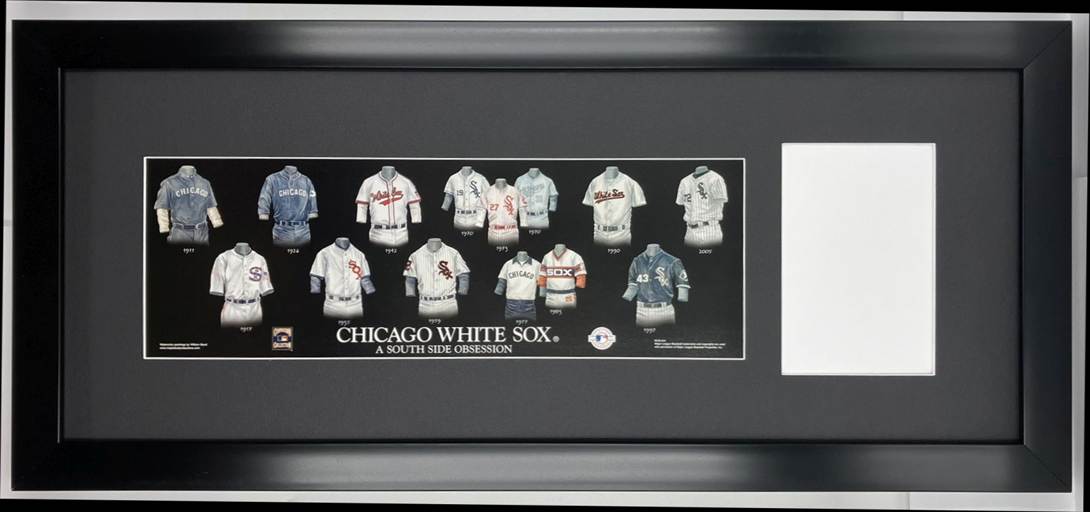
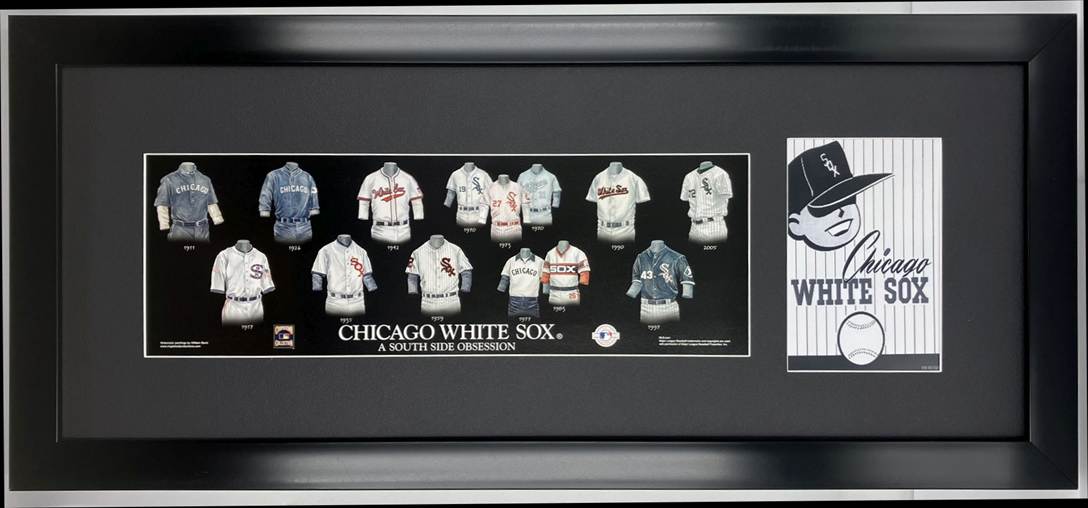
Framed Evolution History Chicago Bears Uniform Print with Your Photo: Framed with our classic, smooth black frame
with glass cover, it measures 11 3/4 inches high x 26 1/4 inches long. The cost for this custom picture is only $79 and there is a one-time $6 discount shipping cost regardless of how many you
order!
Just
add your standard 4 inch x 6 inch photo – whether it’s you in your team jersey,
or team memorabilia or something very creative, your photo possibilities are
endless because you’re only limited by your imagination.
And
you can change your photo as many times as you like!
Here are the easy steps to add your photo:
1. Use a standard 6 inch x 4 inch
photo. Keep in mind the mat will slightly overlap the photo 1/8 inch
on all four sides.
2. Turn the framed picture on its
back and bend up all the flexible tabs used to secure the picture.
3. Remove the white backing.
4. Place your photo over the mat
opening. We have marked guide lines to help you position the photo
perfectly.
5. Secure your photo on all four
sides with strips of the quality Artist’s Tape we have provided.
6. Put back the white backing and
bend back a few of the flexible tabs.
7. Look at the picture to make
sure it looks great. Then bend back the rest of the flexible tabs to
secure your framed picture. You’re Done!
We will of course include a card listing the above
steps with your order. Keep in mind you can
change your
photo as many times as you like!
And if you ever need more tape, just email us and we’ll mail you more
tape at no charge. Our email is listed
on the card.
You can also view our
how-to-do video for our “Team Up With” personalized picture (This how-to-do
video applies to all our personalized framed pictures) here:
Or you can download
our how-to-do video.
Ordering Info:
Or
(You don’t pay Sales Tax when you order from our Shopping Page.)
Click here to return to List of Teams and
Leagues
***************************************
The Chicago White Sox: “A South
Side Obsession”
The Greatest-Scapes is an
accredited business of the Better Business Bureau. We have been a member of the Better Business
Bureau since 1986—and we have an A+ rating.
For more detailed
information about The Greatest-Scapes, please click the BBB Logo at left.
Thank you

E-mail: greatestscapes@hotmail.com
Click here to return to List of Teams and
Leagues
***************************************
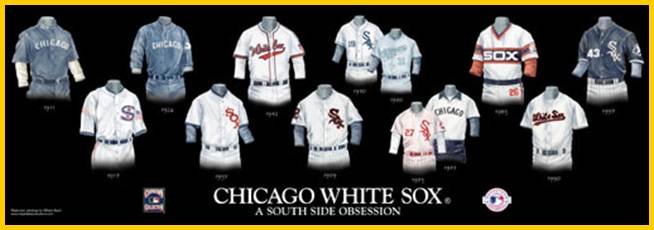
Here is the history of the White Sox’ Uniforms …
#1.
1911 In 1901 the Chicago White Sox franchise began, as did the American
League. The Sox were called the White Stockings, a name that was borrowed from
earlier Chicago baseball teams - in fact the Cubs franchise, which began in
1876, was initially known as the White Stockings!
In the beginning these White
Stockings were owned by Charles Comiskey and managed by the their prize pitcher
Clark Griffith. They won their first American League pennant in 1901, the first
year the AL operated. In 1902 the team name was shortened to the Chicago White
Sox.
This road uniform is from 1911,
the White Sox’s second season at Comiskey Park - their home for the next 80
years! Note the upright collar on this road uniform which is not quite a “cadet
collar”, a style worn a few years later by many major league teams. This jersey
is a pullover style, button-down jersey. If you notice, there is a center belt
loop on the pants. Players of this era usually wore their belt buckle to one
side so they could prevent injury when sliding into a base. Note also the
“W.S.” on the collar, which stands for White Sox, not World Series.
When we look at this jersey we
can’t help but think of photos of a famous member of the White Sox of this era,
Chief Bender.
#2.
1917 This was a special World Series uniform to commemorate the United
States of America’s involvement in World War 1. Notice the flags on both
sleeves. Notice also that this collar is in fact a “cadet collar”, a popular
style worn by many major league teams of this era.
1917 was a great year for the Sox
- after a spectacular regular season with 100 wins and just 54 losses, they
went on to defeat the New York Giants 4 games to 2 and win the World Series. This
was the White Sox’ second World Series victory - their first came in 1906
against the cross-town Cubs. 80+ years later Sox fans around the world are
still waiting for the 3rd World Series Championship - but patience
is a virtue and we know our day will come!
This 1917 uniform is from two
years before the infamous “Black Sox” incident. For those of you who don’t know
baseball history, 8 Sox ballplayers were found guilty of betting against their
own team in the World Series of 1919. All 8 were banned from professional
baseball for life one year later. Those players included the legendary Shoeless
Joe Jackson who batted .375 in the Series, an average which certainly seems to
suggest that he wasn’t trying to throw the series, leading to a debate which
continues to this day.
#3.
1926 What a beautiful uniform! Notice the unusual white collar piping on
this black road uniform - see how it abruptly stops just above the lettering?
In most jerseys the piping then continues down the front of the jersey, but not
this one. Note also the fact that there are two white socks on the left sleeve,
an early team monogram.
#4.
1935 The beauty and simplicity of this home jersey speaks for itself.
Notice especially the bat and ball incorporated into the SOX logo - simple and
elegant design at its best. Notice also the upright blue collar - this is known
as a “cadet” collar, a collar style that was popular in the late teens.
#5.
1942 Note the fact that this jersey has a zippered front. During the
40’s, 50’s and 60’s many teams used zippered jerseys instead of the more
traditional button front jerseys, while a handful of teams wore them well into
the 70’s and even the 80’s. The Reds, Yankees and A’s were the three pre-1977
major league teams that never wore zippers. The 1937 Cubs were the first team
to wear a zippered jersey, and as far we can tell the 1988 Phillies were the
last to wear one. For the White Sox, the zippered front jersey began in 1938
and continued until the 1955 season.
The colors of this uniform are
red, white and blue, done at least in part to honor the fact that America had
entered World War II.
During the Second World War, the
question is raised, should able-bodied athletes of baseball be fighting for
their country rather than playing baseball? Baseball Commissioner Landis asked
President Franklin D. Roosevelt what to do - here is part of Roosevelt’s reply:
“I honestly feel it would be best
for the country to keep baseball going. There will be fewer people unemployed
and everybody will work longer hours and harder than ever before… Here is
another way of looking at it - if 300 teams use 5,000 or 6,000 players, these
players are a definite recreational asset to at least 20,000,000 of their
fellow citizens - and that in my judgment is thoroughly worthwhile.”
Wartime sleeve patches were worn
by all levels of professional baseball teams between 1942 and 1945. A “Health”
patch (seen on this jersey) was worn during the 1942 season, part of a war-time
health and fitness awareness campaign, and from 1943-1945 a “Stars and Stripes”
was worn.
#6.
1959 After having no pinstripes on their uniforms since 1932, the Sox
began wearing pinstripes on their 1951 home uniform and continued to do so
until 1968. Also of interest on this home uniform are the uniform numbers on
the sleeves of the jersey - a new addition. Uniform numbers first made their
appearance on the front of a uniform in 1952 - the Brooklyn Dodgers were the
first team to wear uniform numbers on the front of their jersey. The Braves
followed suit in 1953, and the Reds joined in beginning in 1956. The 1916
Cleveland Indians actually wore a uniform number on their sleeve, but it wasn’t
until the ’52 Dodgers that the number made it to the front. The classic Sox
logo, as seen on this 1959 uniform, first appeared on the 1949 home uniform.
In 1959, after a 40+ year absence,
the White Sox make it to the World Series. Despite winning game one 11-0 and
having the great Nellie Fox and Luis Aparicio in their lineup and a career year
from starter Bob Shaw, the Sox fall to the now Los Angeles Dodgers 4 games to
2. This is the last year the Sox made it to the World Series, but hope springs
eternal in the hearts of Sox fans!
#7A. & #7B.
1970 The White Sox continue to change the look of their uniform,
although they continue to come up with clean, classic looks. On both of these
home and road uniforms, uniform numbers appear on the front of the jersey.
Uniform numbers first made their appearance on the front of a uniform in 1952 -
the Brooklyn Dodgers were the first team to wear uniform numbers on the front
of their jersey. The Braves followed suit in 1953, and the Reds joined in
beginning in 1956. The 1916 Cleveland Indians actually wore a uniform number on
their sleeve, but it wasn’t until the ’52 Dodgers that the number made it to
the front. The home jersey is reminiscent of a Tigers or Red Sox uniform.
The road uniform is more blue than
gray, and has a great thick “swoosh” under the Chicago script - note how the
swoosh has “White Sox” written on it. It’s unusual for a baseball jersey to have
both the name of the team and the city on the uniform at the same time, as this
jersey does.
#8A.
1973 After complimenting the White Sox on their great taste through the
years, we have to say that the mid 70’s to early 80’s weren’t their proudest
moment. Some people say the Sox had some of the ghastliest uniforms in all of
baseball for a 10 year period, although we wouldn’t go that far (for proof, see
the Padres!).
What we can say about both these
uniforms is that they are of a double-knit style that most major league teams
succumbed to during the 70’s and early 80’s. It was a pullover style, made of
stretchy, synthetic material. The pants were called “Sans-a-Belt”’s because the
elasticized waistline eliminated the need for a belt. Notice also that the 1973
jersey brought back the zippered front, and the left sleeve patch is the Sox
logo in a red circle.
#8B.
1977 The 1977 uniform was especially unusual. Note the collar on this
pullover style home uniform. Professional baseball hadn’t seen collars this large
since the early 1910’s. Also unusual was the fact that the Sox also wore this
jersey with shorts - we’re not sure today’s ballplayer would put up with this
fashion statement, but in the 70’s almost anything went!
We can’t write about the Sox
without bringing up the name of the team owner Bill Veeck. Veeck was a famous
promoter and among other things staged all sorts of wacky and fantastic events
to bring people to the ballpark through the years. Perhaps the most famous was
“Disco Demolition Night” on July 12, 1979. This was a promotion gone awry –
thousands of fans ended up throwing their records on the field and at the
players, and fortified by beer, then rushed the field. The field was torn up so
badly that the second game of the double header had to be cancelled (and
forfeited by the Sox)! If you haven’t heard of Bill Veeck, you should really
read about him. Check out a book called “Veeck -- As In Wreck” by Bill Veeck
with Ed Linn, University of Chicago Press, 2001. In many ways Veeck was years
ahead of his time.
#9.
1983 Do you love it or hate it? This home uniform is still the double
knit pullover style, with the “Sans-a-Belt” waistband, but features a unique
horizontal band across the jersey and arms with a funky “Sox” in the middle.
The patch on the left sleeve commemorates the 50th All-Star game,
held at Comiskey Park this year. Note also the unusual touch of putting the
uniform number on the pants instead of on the front or sleeve of the jersey,
something the Sox started doing in 1982. When we see this uniform we can’t help
be reminded of the great catcher and Hall of Famer, Carlton Fisk.
#10.
1990 As you can see on this home uniform, the Sox have finally left the
double knit, sans-a-belt era behind them - thank goodness! This 1990 home
uniform harkens back to a 1940’s style, and features a much more classic
looking White Sox logo.
1990 is the White Sox’ final
season at Comiskey Park, ending a run that began on July 1st, 1910.
The next season the Sox moved into a brand new park, also named Comiskey Park,
right across the street from the original. With the demolition of Comiskey I in
1991, America lost yet part of its past and yet another classic ballpark was
gone.
#11.
1997 The Sox had a number of different jerseys and pants as part of
their uniform repertoire this year, and they would mix and match among them
from one game to the next. This 1997 uniform jersey features the classic Sox
logo from the 50’s, 60’s & early 70’s, as well as small white sock on the
left sleeve. This black jersey really shows a lot of respect for the White Sox
team history. And when we see this uniform we can’t help but think of Frank
“The Big Hurt” Thomas, a White Sox fixture and home run phenom.
If we could see the full right
sleeve of this jersey, we would see a patch honoring the 50th
anniversary of Jackie Robinson breaking baseball’s color barrier. All teams
wore this patch in honor of Jackie Robinson and all he achieved, and all MLB
teams retired his number 42 - the first time in the history of the big four
North American sports (MLB, NFL, NBA, NHL) that a number has been universally
retired. And for the White Sox and their
fans there was one other historical number:
2005 WORLD SERIES CHAMPIONS!!!