Personalized!
A Powerful, Classy, and Creative way
to be joined at the hip with your favorite team
(And of course the uniforms print
will never go “out of Fashion” because a team’s uniforms are forever.)
You
can hang it, lean it, or let it lay flat.
Framed Version 3
Personalized
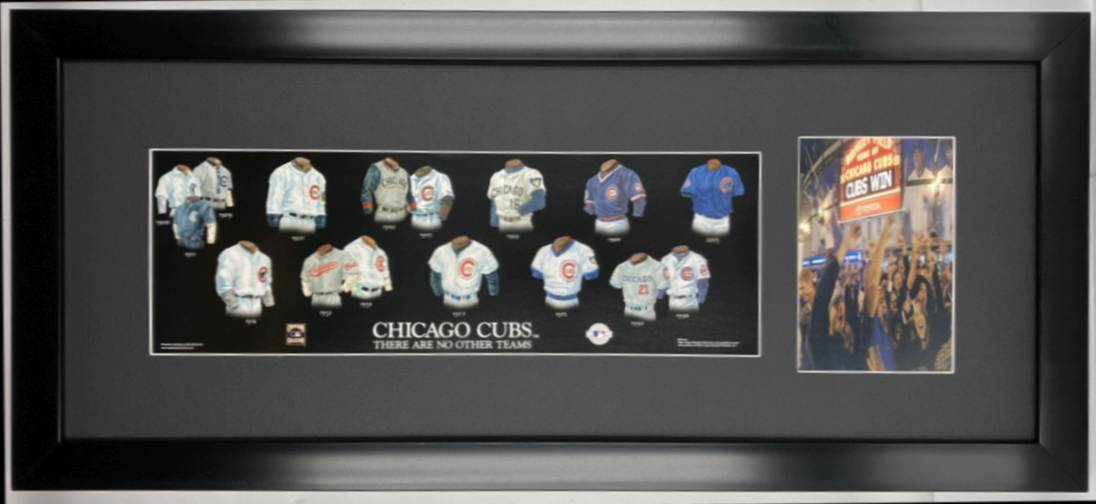
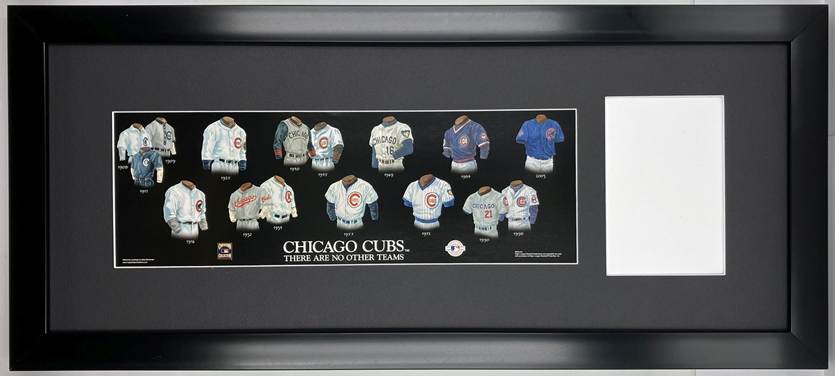
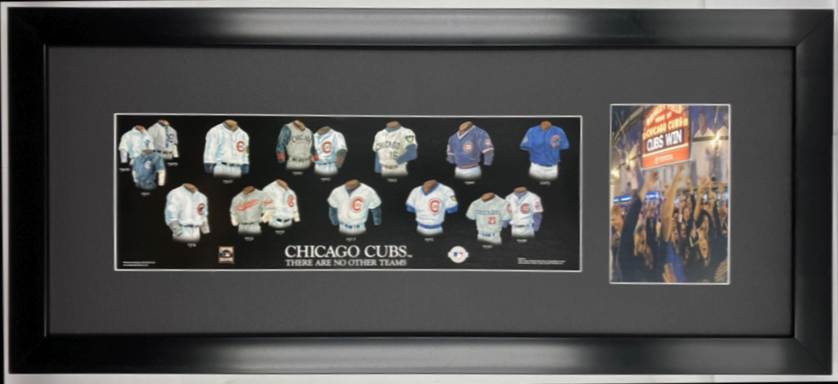
Framed Evolution History Chicago Cubs Uniform Print with Your Photo: Framed with our classic, smooth black frame
with glass cover, it measures 11 3/4 inches high x 26 1/4 inches long. The cost for this custom picture is only $79 and there is a one-time $6 discount shipping cost regardless of how many you
order!
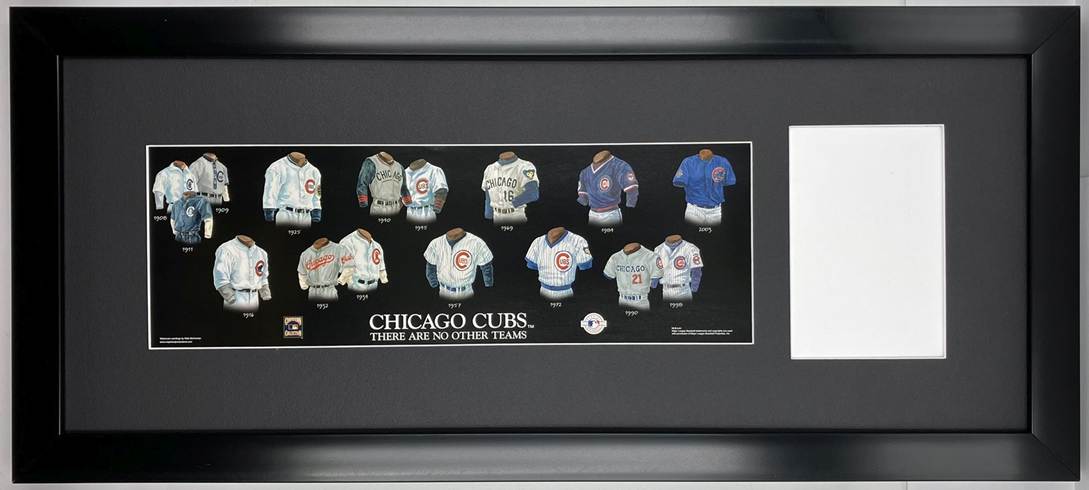
Just
add your standard 4 inch x 6 inch photo – whether it’s you in your team jersey,
or team memorabilia or something very creative, your photo possibilities are
endless because you’re only limited by your imagination.
And
you can change your photo as many times as you like!
Here are the easy steps to add your photo:
1. Use a standard 6 inch x 4 inch
photo. Keep in mind the mat will slightly overlap the photo 1/8 inch
on all four sides.
2. Turn the framed picture on its
back and bend up all the flexible tabs used to secure the picture.
3. Remove the white backing.
4. Place your photo over the mat
opening. We have marked guide lines to help you position the photo
perfectly.
5. Secure your photo on all four
sides with strips of the quality Artist’s Tape we have provided.
6. Put back the white backing and
bend back a few of the flexible tabs.
7. Look at the picture to make
sure it looks great. Then bend back the rest of the flexible tabs to
secure your framed picture. You’re Done!
We will of course include a card listing the above
steps with your order. Keep in mind you can
change your
photo as many times as you like!
And if you ever need more tape, just email us and we’ll mail you more
tape at no charge. Our email is listed
on the card.
You can also view our
how-to-do video for our “Team Up With” personalized picture (This how-to-do
video applies to all our personalized framed pictures) here:
Or you can download
our how-to-do video.
Ordering Info:
Or
(You don’t pay Sales Tax when you order from our Shopping Page.)
Click here to return to List of Teams and
Leagues
***************************************
The Chicago Cubs: “There Are No
Other Teams”
The Greatest-Scapes is an
accredited business of the Better Business Bureau. We have been a member of the Better Business
Bureau since 1986—and we have an A+ rating.
For more detailed
information about The Greatest-Scapes, please click the BBB Logo at left.
Thank you

E-mail: greatestscapes@hotmail.com
Click here to return to List of Teams and
Leagues
***************************************
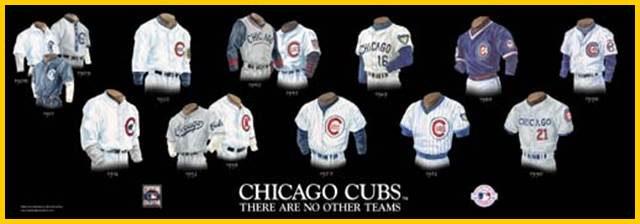
Here is the history of the Cubs’ Uniforms …
#1A.
1908
In 1876, the Chicago White
Stockings (yes - the Cubs used to be called the White Stockings!) become one of
eight charter members of the National League.
On April 25, 1876 the team plays the first game in the history of the
Chicago National League Ball Club. A.G. Spalding doubles as the manager and
pitcher, and he records the first NL shutout, a 4-0 win over Louisville. The
White Stockings go on to win the inaugural National League championship with a
record of 52-14.
Using nicknames such as the
"White Stockings," "Colts," and Orphans," the team
plays in five different ball parks in the 1800s. The origin of the name Cubs
isn’t precisely known, but one story has it that in 1901 and 1902 the team was
full of rookies and on March 27, 1902 a reporter in the Chicago Daily News
referred to the team as the “Cubs”, a name that eventually stuck.
The jersey depicted here is a 1908
home jersey with a full pull-down collar. The logo is a brown bear standing on
its hind legs holding a bat. Even though this jersey has several buttons down
the front, it still was a “pullover” style jersey that had to be pulled over
top of the head.
In 1908, for the third year in a
row, the Cubs headed to the World Series. In 1906 they fell to the cross-town
rival White Sox; while in 1907 they won four straight over the Tigers. In this
season, 1908, the Cubs and Tigers met again, with the Cubs winning the World
Series 4 games to 1. Even the presence of Detroit’s legendary Ty Cobb wasn’t
enough to overcome the Cubs of the early 1900’s. In the 1908 Series Cobb was
held to just 4 hits and 2 stolen bases in the 5 games, as the Cubs went on to
become the first team to win back-to-back World Series Championships.
The Cubs have had a dry spell
since 1908, but despite this drought, Cubs’ fans are ever hopeful and remain
among the most loyal fans in all of baseball.
#1B.
1909 The Cubs are one of the first major league teams, (along with the
Boston Braves & Brooklyn Dodgers) to implement pinstripes as a part of
their uniforms, a practice that actually began with their 1907 World Series
uniform. The 1909 collar on this road uniform is cadet style. Note also the
“CHICAGO” down the front of the jersey - a wonderful touch we’d love to see
repeated by a modern team. Just like the 1908 jersey, there are buttons down
the front of this jersey, but it’s still a “pullover style” jersey.
1909 is the first year that the
Cubs had a large “C” with a smaller “ubs” inside of it. This jersey is from the
Cubs’ most successful era, when they made it to the World Series 4 times in 5
years, (1906, 1907, 1908 & 1910) winning it all in 1907 and 1908.
#1C.
1911 The collar on this dark blue road jersey is halfway between a cadet
style and the style of today. This is a pullover style jersey, even though it
has some buttons down the front, it still had to be pulled over the head. A
white bear inside a white “C” appears on this jersey, slightly different than
previous logos, but the theme remains the same, a bear and a bat.
Note also how there is a center
belt loop and how the belt buckle is worn to one side. Players of this era
usually wore the belt buckle to one side to prevent injury when sliding into a
base.
#2.
1916 The logo changes once again on this home uniform, now it’s a red
“C” and a blue bear on all fours. The 1916 season is of great interest to Cubs
fans because it was the first year the Cubs played in what we all know now as
“Wrigley Field”.
Prior to 1916 the Cubs played
their home games at the West Side Grounds. In 1916 Charles Weeghman purchased
the team & moved them to “Weeghman Park” for the 1916 season. This ballpark
had been built two years earlier and was home to the Federal League’s Chicago
Whales until the League folded in 1915. The first National League game played
at Weeghman Park was on April 20th, 1916 when the Cubs beat the
Cincinnati Reds 7-6 in 11 innings.
The Cubs were sold to William
Wrigley in 1920, & the park was renamed “Cubs Park”. Then in 1926 the name
was changed to Wrigley Field, the name we know and love today.
#3.
1925 This home uniform is still a pullover style jersey with a cadet
collar. They stuck with the large red “C” and went with the “ubs” inside of it,
similar to the 1909 logo. The patch on the left sleeve commemorates the 50th
anniversary of the National League. On April 14th, 1925 the 1st
regular season radio broadcast of a Cubs game hit the air on WGN Radio, with
Quin Ryan calling the play by play. Chicago beat Pittsburgh 8-2.
#4A.
1932 Most baseball fans know that teams typically wear the name of their
city on their road uniforms and their nicknames for their home uniforms - this
has been done for over 100 years. What makes this jersey interesting is that
only a handful of Major League teams have ever worn a jersey with both the
team’s city AND nickname appearing on the same jersey, such as is the case
here.
The Cubs wore this pullover style
road uniform for the 1932 and 1933 seasons. In 1932 the Cubs made it to the
World Series and thus faced Babe Ruth and the New York Yankees. In Game 3,
October 1st, the story is told that while The Babe was at bat in the
5th inning, he paused, pointed to the right-centerfield bleachers,
and “called his shot”. The next pitch ended up in the seats where he had
predicted. The Yankees swept the Series in 4 games.
On a sad note, both former owner
Charles Weeghman & current owner William Wrigley passed away this year.
Wrigley’s son Philip Knight, “P.K.” took over for his father.
#4B.
1934 This is a full button-down front home uniform (as opposed to the
pullover style jersey) with distinctive red and blue piping around the collar
and cuffs. The logo is a bear cubs winding up to pitch, but we have to admit it
looks as much like an ape as it does a bear.
The Cubs made it to the World
Series 3 times in the 30’s but were defeated by the Yankees in 1932, the Tigers
in 1935 and the Yankees again in 1938.
A1930’s point of interest:
In September 1937 Bill Veeck
planted the ivy that now covers the brick wall of Wrigley Fields’ outfield. The
ivy has become synonymous with Wrigley Field, & gives outfielders a second
thought about tracking a fly ball to the wall.
#5A.
1940 The Cubs have abandoned the traditional jersey and have introduced
a vest with stylized undershirt complete with red striped cuffs. This is the
first time a vest was worn by a major league team, and the Cubs wore a vest for
the 1940-1942 seasons. (The next team to wear a vest was the 1956 Cincinnati
Reds.)
Notice also the zippered front on
this road uniform. The 1937 Cubs were the first team to wear a zippered jersey,
with the White Sox and Tigers joining in the following year. During the 40’s,
50’s and 60’s many teams used zippered jerseys instead of the more traditional
button front jerseys, while a handful of teams wore them well into the 70’s and
even the 80’s. The Reds, Yankees and A’s were the three pre-1977 major league
teams that never wore zippers. As mentioned above, the 1937 Cubs were the first
team to wear a zippered jersey, and as far we can tell the 1988 Phillies were
the last to wear one.
Perhaps the most unusual part of
this jersey is the uniformly thin underline under the “Chicago”. Usually
baseball uniforms feature more of a “swoosh” underline, like the 1932 jersey.
It’s interesting to note that in
1940 Wrigley Field was about to become one of the first ballparks with lights,
to allow night games, but when World War II began, the team donated them to the
war effort. As it turns out, the Cubs ended up being the last team to get
lights, & played their first night game at Wrigley in 1988.
#5B.
1945 This is a classic uniform, one of our favorites! Note that the red
stripes on the cuffs of the undershirt are still present (see the 1940 jersey).
During the Second World War, the
question is raised, should able-bodied athletes of baseball be fighting for
their country rather than playing baseball? Baseball Commissioner Landis asked
President Franklin D. Roosevelt what to do - here is part of Roosevelt’s reply:
“I honestly feel it would be best
for the country to keep baseball going. There will be fewer people unemployed
and everybody will work longer hours and harder than ever before… Here is
another way of looking at it - if 300 teams use 5,000 or 6,000 players, these
players are a definite recreational asset to at least 20,000,000 of their
fellow citizens - and that in my judgment is thoroughly worthwhile.”
Wartime sleeve patches were worn
by all levels of professional baseball teams between 1942 and 1945. A “Health”
patch was worn during the 1942 season, part of a war-time health and fitness
awareness campaign, and from 1943-1945 a “Stars and Stripes” was worn.
Now we have to fess up - some of
our Cubs’ posters show the “Health” patch on the 1945 uniform - this wasn’t the
case, we should have shown the Stars & Stripes patch. As noted above, the
health patch was only worn in 1942. Sorry for the mix-up!
In 1945 the Cubs made it to the
World Series, but fell to the Tigers 4 games to 3, losing to the Tigers at
Wrigley Field in Game 7 by a 9-3 score. The Cubs have to wait until 1984 to
make it back to post season play.
#6.
1957 In this home uniform we see the first appearance of pinstripes for
the Cubs since the early 1930’s. Notice the Cubs logo and how similar it is to
that of today. By 1957 the great Ernie Banks, Mr. Cub, was playing his 5th
season, batting .285 and knocking in 102 runs.
#7.
1969 Numbers are added to the front of this road jersey for the first
time. Uniform numbers first made their appearance on the front of a uniform in
1952 - the Brooklyn Dodgers were the first team to wear uniform numbers on the
front of their jersey. The Braves followed suit in 1953, and the Reds joined in
beginning in 1956. The 1916 Cleveland Indians actually wore a uniform number on
their sleeve, but it wasn’t until the ’52 Dodgers that the number made it to
the front. The Cub face patch seen on the left shoulder made its first
appearance in 1962. If we could see the right sleeve of this jersey, we would
see a patch worn by all MLB teams that commemorated the 100th
anniversary of professional baseball. When I see this jersey, I can’t help but
think of two great Cubs - shortstop-turned first baseman Ernie Banks and the
great Ferguson Jenkins, who had six 20+ game winning seasons in a row with the
Cubs from 1967-1972.
#8.
1972 This home jersey is of a double-knit style that most major league
teams succumbed to during the 70’s and early 80’s. It was a pullover style,
made of stretchy, synthetic material. The pants were called “Sans-a-Belt”’s
because the elasticized waistline eliminated the need for a belt. This was a
successful era for the Cubs, who finished either 2nd or 3rd
and above .500 for 6 straight years (1967-1972), but could never quite make it
to post season play.
#9.
1984 This road uniform is still the double knit pullover style, with the
“Sans-a-Belt” elastic waistline. Notice the new bear patch on the left sleeve.
The patch on the right sleeve
celebrates the fact that the Cubs were the National League Eastern Division
Champs (they finished with a 96-65 regular season record) and made it to the
post season for the first time since 1945! But in the National League
Championship Series against the Padres, the Cubs win the first two games to
take a commanding 2-0 lead in the best-of-five series, then drop the next 3
games (all in San Diego) and fail to make it to the World Series.
#10.
1990 Thank goodness - by now the double knit, Sans-A-Belt era has
finally come to an end! Grown men shouldn’t have to play ball in polyester!
This 1990 road uniform has the
uniform numbers on the front once again. The familiar Cubs logo as we know it
today is on the left sleeve. The right sleeve has a patch that the Cubs wore
all season long. This patch commemorates the fact that the Cubs & Wrigley
Field played host to the 1990 All Star game. This practice, where the team
which hosts the all-star game wears a patch commemorating the game, began in
the 1970’s and continues today.
#11.
1998 This home uniform shows a circle C and walking bear logo on the
left sleeve, a logo that is reminiscent of the 1916 jersey logo. Note also the
fact that there is a blue and white “Hey Hey” on the left sleeve just above the
bear logo. This expression is a tribute to longtime Cubs announcer Harry Caray,
who passed away prior to the ’98 season. On the right sleeve, which we cannot
see, the Cubs wore a simple but unmistakable black and white caricature of
Harry Caray.
In this famous season, 1998, Sammy
Sosa of the Cubs and Mark McGwire of the Cardinals battled head to head in an
awesome home run race that captured the attention of a nation and may have
helped to revitalize the entire sport of baseball. It could be argued that the
uniforms of the Chicago Cubs and the St. Louis Cardinals were the most
photographed jerseys in the entire history of professional baseball as McGwire
slugged 70 home runs to Sosa’s 66 - a feat that may not be repeated in our
lifetimes.