Personalized!
A Powerful, Classy, and Creative way
to be joined at the hip with your favorite team
(And of course the uniforms print
will never go “out of Fashion” because a team’s uniforms are forever.)
You
can hang it, lean it, or let it lay flat.
Framed Version 3
Personalized
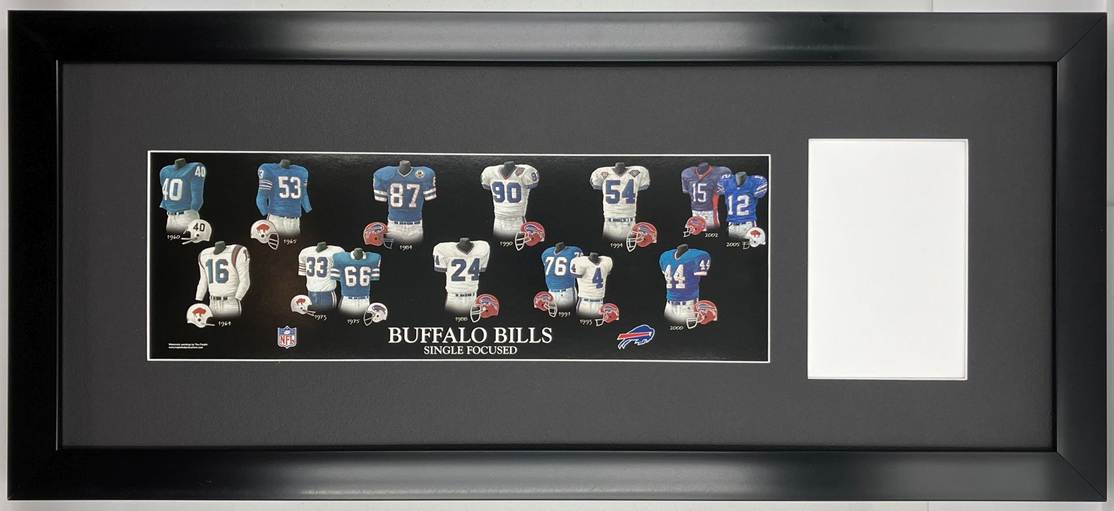
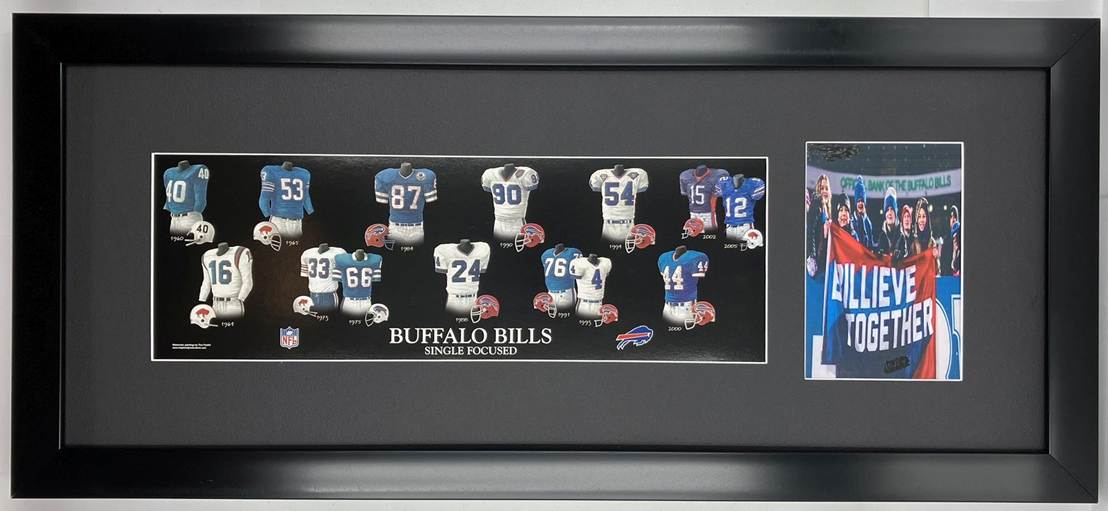
Framed Evolution History Buffalo Bills Uniform Print with Your Photo: Framed with our classic, smooth black frame
with glass cover, it measures 11 3/4 inches high x 26 1/4 inches long. The cost for this custom picture is only $79 and there is a one-time $6 discount shipping cost regardless of how many you
order!
Just
add your standard 4 inch x 6 inch photo – whether it’s you in your team jersey,
or team memorabilia or something very creative, your photo possibilities are
endless because you’re only limited by your imagination.
And
you can change your photo as many times as you like!
Here are the easy steps to add your photo:
1. Use a standard 6 inch x 4 inch
photo. Keep in mind the mat will slightly overlap the photo 1/8 inch
on all four sides.
2. Turn the framed picture on its
back and bend up all the flexible tabs used to secure the picture.
3. Remove the white backing.
4. Place your photo over the mat
opening. We have marked guide lines to help you position the photo
perfectly.
5. Secure your photo on all four
sides with strips of the quality Artist’s Tape we have provided.
6. Put back the white backing and
bend back a few of the flexible tabs.
7. Look at the picture to make
sure it looks great. Then bend back the rest of the flexible tabs to
secure your framed picture. You’re Done!
We will of course include a card listing the above
steps with your order. Keep in mind you can
change your
photo as many times as you like!
And if you ever need more tape, just email us and we’ll mail you more
tape at no charge. Our email is listed
on the card.
You can also view our
how-to-do video for our “Team Up With” personalized picture (This how-to-do
video applies to all our personalized framed pictures) here:
Or you can download
our how-to-do video.
Ordering Info:
Or
(You don’t pay Sales Tax when you order from our Shopping Page.)
Click here to return to List of Teams and
Leagues
***************************************
The Buffalo Bills: “Single Focused”
The Greatest-Scapes is an
accredited business of the Better Business Bureau. We have been a member of the Better Business
Bureau since 1986—and we have an A+ rating.
For more detailed
information about The Greatest-Scapes, please click the BBB Logo at left.
Thank you

E-mail: greatestscapes@hotmail.com
Click here to return to List of Teams and
Leagues
***************************************
Here is the history of the Bills’ Uniforms …
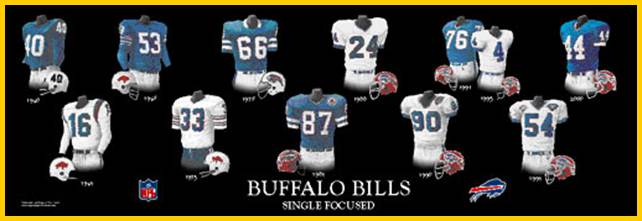
#1.
1960 Even though it’s a tenuous connection, let’s start the story of the
Buffalo Bills with the birth of the All-America Football Conference (AAFC) in
1946. The AFL was a league established to rival the long since established NFL.
In its inaugural season the AFL had 8 teams: Brooklyn Dodgers; Buffalo Bisons;
Chicago Rockets; Cleveland Browns; Los Angeles Dons; Miami Seahawks; New York
Yankees; San Francisco 49ers. It gets a bit confusing because one might assume
that at least 3 of these teams (Buffalo Bills, Cleveland Browns and the 49ers)
went on to join the NFL in 1950 when the AAFC and the NFL agreed to a truce,
but in fact the deal was that the NFL would take in the AAFC’s two best teams,
the Browns and the 49ers, plus the lowly Baltimore Colts (who folded after one
season in the NFL). The rest of the AAFC teams simply ceased operations.
Getting back to Buffalo in the
AAFC, the 1946 team was known as the Bisons. Prior to the 1947 season, a
contest was held to rename the team, which was owned by James Breuil of the
Frontier Oil Company. One entry suggested the name “Bills”, in honor of the
famous western frontiersman, Buffalo Bill Cody. Carrying the “frontier” theme
further, the entrant further suggested that the team was being supported by
Frontier Oil and was “opening a new frontier in sports in Western New York.” As
you can imagine, the team was renamed the “Bills”.
As mentioned above, however, when
the AAFC folded up shop after the 1949 season, so did the Bills.
Now turn the hands of time ahead
to 1959, and the birth of the American Football League (AFL), which was to
begin operations in 1960 as an 8-team rival league to the NFL. On October 28th,
1959, Ralph C. Wilson is awarded the AFL’s 7th franchise and thus
Buffalo was back in the world of professional football and joined the following
teams in the AFL: New York Titans (now Jets); Dallas Texans (now Kansas City
Chiefs); Los Angeles Chargers (now San Diego Chargers); Houston Oilers (now
Tennessee Titans); Boston Patriots (now New England Patriots); and Denver
Broncos. The Oakland Raiders became the AFL’s 8th and final
franchise after the Minnesota franchise (which would go on to become the
Vikings) opts out of the AFL for the NFL before they play a single game.
When it came time to name
Buffalo’s new AFL team, the name of Buffalo’s earlier pro football team, the
AAFC’s Bills, was adopted.
Both the AFL and NFL competed head
to head for players, fans and broadcast revenue. This was the way it was from
1960 to 1965 - two separate leagues, two separate champions, although few
people would have honestly believed that the AFL champion could have beaten the
NFL champs. Then in 1965 the two leagues agreed to merge. It was decided that
beginning in 1970 there would be only one league, the NFL. In the interim,
between 1966 and 1969, the AFL Champion would play the NFL Champion for the
“World Championship”. It was only after the first World Championship had been
played in 1966 that the name “Super Bowl” came into being.
The Bills began play in 1960 at
the inner city War Memorial Stadium, and stayed there for 13 seasons. During
that time the Bills saw the capacity rise from 26,000 to 45,748.
A final stadium note: In 1973,
owner Ralph C. Wilson moved the Bills to “Rich Stadium” in suburban Orchard
Park, NY. And turn the hands of time ahead almost 30 years, and the owner is
still Ralph C. Wilson. In fact, so revered is Wilson that in 1998, civic
leaders decided to honor him and renamed the Bills’ stadium "Ralph Wilson
Stadium."
This blue Bills jersey has white
numbers on both the front and the sleeves – note how high up the sleeve numbers
are. The helmet is white with black numbers – interesting since the team’s
predominant color is clearly blue.
As for on the field, the Bills
finish year one 5-8-1, good for 3rd place in the 8 team AFL.
#2.
1964 The Bills’ first .500+ season was in 1962 when they finished 7-6-1.
The following season, 1963, the Bills tied the Boston Patriots with identical
7-6-1 records, and thus the two teams faced each other in a one game playoff in
Buffalo to decide who would advance to the AFL Championship game. This was
Buffalo’s first ever playoff game, but home field advantage didn’t help them as
Boston won 26-8.
But in 1964, the Bills won the AFL
East outright with a league best 12-2 record. Leading the team were QB Jack
Kemp and running back Cookie Gilchrist. The AFL Championship was played in
Buffalo on December 26th, 1964, and after giving up an early 7-0
lead to the San Diego Chargers, the bills never looked back as they won the AFL
Championship by a score of 20 – 7.
This white ROAD jersey has blue
numbers with a red outline on the front and sleeves. There are also blue and red
stripes around the shoulders, the only era in Bills history that the jersey had
these vertical stripes. Note that the helmet now has a red buffalo on the side
as well as stripes on the top. This is not the more famous “charging buffalo
that the Bills have used for the last 25 years, instead it’s a rather peaceful
looking buffalo.
#3.
1965 The Bills are back at it again in 1965. Their 10-3-1 record is tops
for wins in the league, and it earns them the right to play the 9-2-3 San Diego
Chargers in San Diego at Balboa Stadium.
Once again the AFL Championship is
played on December 26th, and once again the Bills set the Chargers
back on their heels, this time by a 23-0 score.
They say timing is everything, and
had this been 1966 instead of 1965, the Bills would have gone on to play the
NFL Champion for the “World Championship” (it was only after the first World
Championship had been played in 1966 that the name “Super Bowl” came into
being). But the AFL and NFL hadn’t yet agreed to a merger, thus each league was
satisfied with crowning their own champion and leaving it at that. (See below
for more on the AFL-NFL merger.)
The Bill’s coach from 1962 to 1965
was Lou Saban, but after being named AFL Coach of the Year in 1964 and 1965,
Saban left Buffalo and resurfaced in Denver a year later.
Before we leave the 1960’s, the
Bills had one last good season. In 1967 the Bills finished 9-4-1, winning the
AFL East and thus faced someone other than the Chargers in the AFL Championship
for the 1st time in 3 seasons. The opponent was the Kansas City
Chiefs, and the Chiefs handed the Bills a 31-7 home loss. Had the Bills won,
they would have played in the “World Championship” game (which was later
renamed Super Bowl I).
The period of time between 1966
and 1969 warrants a bit of explanation. The 8 team AFL began in 1960 as a rival
league to the NFL - both leagues competed head to head for players, fans and TV
revenue. And thus it was for 5 years - two separate leagues, two separate
champions (although few people would have honestly believed that the AFL
champion could have beaten the NFL champs). Then in 1965 the two leagues agreed
to merge. It was decided that beginning in 1970 there would be only one league,
the NFL, and that between 1966 and 1969 the AFL Champion would play the NFL
Champion for the “World Championship”. It was only after the first World
Championship had been played in 1966 that the name “Super Bowl” came into
being.
Thus the 1966 season saw the first
meeting of the AFL and NFL champions, with the NFL Champion Green Bay Packers
humbling the AFL’s KC Chiefs 33-10. (Even though the game was played in 1967,
most football historians refer to this as the 1966 Super Bowl because it was
the culmination of the 1966 season.) The NFL superiority was on display again in
1967, when the NFL’s Packers pounded the AFL’s Raiders 33-14.
Then came 1968 and the stunning
upset - the AFL’s NY Jets shocked the football world by beating the NFL’s
heavily favored Baltimore Colts 16-7.
This 1965 blue HOME jersey has
white numbers with a red outline, both on the front and sleeve numbers. There
are also white and red horizontal stripes around the sleeves. The helmet has a
red buffalo on the side as well as stripes on the top.
#4.
1973 This white ROAD jersey has blue numbers with a red outline on the
front and sleeves, which are short sleeves. There are also double rows of red
and blue horizontal stripes around the shoulders. In an interesting switch, the
pants have changed from white to blue, with red and white stripes down the sides.
The helmet has a red buffalo on the side as well as stripes on the top.
As noted earlier, Buffalo lost to
the Kansas City Chiefs in the 1966 AFL Championship game. In so doing, the
Bills just missed playing in Super Bowl I. Then, during the next five seasons,
they sank to the bottom, winning only 13 games while losing 55 and tying two.
The two most frightening seasons were 1968, when they went 1-12-1 (partly
attributable to the fact that they were without star QB Jack Kemp all season),
and 1971, when they could only manage a single win against 13 losses.
Interestingly, the Bills drafted
OJ Simpson out of USC in 1969, but Simpson was held back and gained only 697
yards in 1969, 488 in 1970, and 742 in 1971. Then in 1972, Coach Lou Saban
returned to coach the Bills and made the decision to let O.J. Simpson carry the
team. Smart move. Once again, the Bills were competitive, going 4-9-1 in 1972
and then 9-5 in 1973. And the responsibility certainly didn't bother the Juice:
he ran for 1251 yards in 1972, then in 1973 he rushed for a stunning
league-record 2,003 yards!
#5.
1975 This is a blue HOME jersey with white numbers on the front and
sleeves. There are also white and red stripes around the sleeves. The helmet is
still white but has a new “charging buffalo” logo on the side as well as
stripes on the top. We have chosen to show a foam neck collar because many
Bills players wore foam collars in this era.
The Bills made the playoffs in
1974, but fell to the powerful, Super Bowl bound Steelers 32-14. In 1975, the
year depicted by this jersey, the Bills finished 8-6 but out of the playoffs,
and they would remain on the outside looking in until making the playoffs again
in 1980. Simpson, however, had another monster year in 1975, gaining 1817 yards
on the ground. This would be his second to last big season, and third to last
season as a Bill. (Can you name where Simpson played after the Bills, and for
how long?)
#6.
1984 This is a blue jersey with white numbers on the front and sleeves.
There are also white and red stripes around the sleeves, only now the stripes
extend to the end of the sleeve cuff. There is also a small red and white
collar on this jersey. Of note is the helmet, which is red and features the
blue buffalo logo on the side.
The patch on the left shoulder celebrates the silver anniversary of the
founding of the AFL (American Football League). Each of the original AFL teams
(Buffalo, Oakland, San Diego, Kansas City, Denver, San Francisco, Patriots,
Jets) wore this patch in 1984. But the particularly interesting thing about
this patch is that each team wore a different version, one that incorporated
the team logo into the patch.
In 1984 the Bills are in the midst
of a horrible slump. They go 4-5 in the strike shortened 1982 season and 8-8 in
’73, but then the bottom drops out and the Bills finish out of the playoffs
until 1988.
But 1986 and the coaching era of
Marv Levy is about to begin, and thus the future is looking quite bright.
#7.
1988 This is a white ROAD jersey with blue numbers and red trim on the
front and sleeves. In a departure from previous road jerseys, there are single
blue stripes at the cuffs of the sleeves. The helmet is red with the charging
blue buffalo logo.
The team’s steady improvement
under 3rd year head coach Marv Levy is evident, and in 1988 the
Bills finish a highly respectable 12-4. But perhaps the Bills rise also had a
little something to do with the 1986 arrival of QB Jim Kelly and the 1985
addition of Bruce Smith. Or the 1988
arrival of Thurmon Thomas .
Regardless of what the reason, the
Bills make the playoffs for the 1st time since 1981, and more
importantly, notch their first playoff victory since 1965. The win came on New
Years Day in Buffalo. The opponent was the Houston Oilers, and the final score
was 17-10.
Next up were the surprising Kansas
City Chiefs who tied with the Bills and the Chicago Bears for the league’s best
record at 12-4. But in the AFC Championship Game, played in Cincinnati at
Riverfront Stadium, the Bengals down the Bills 21-10.
But don’t despair, something
special is brewing…
#8.
1990 Oh Baby what a season!
The Bills go 13-3 for their 2nd
best winning percentage ever (they went 12-2 in 1964 in their first AFL
Championship season). The names trip off the tongue: Don Beebe, Cornelius
Bennett, Shane Conlon, Jim Kelly, James Lofton, Pete Metzelars, Scott Norwood
(be kind!), Andre Reed, Bruce Smith, Darryl Talley, Steve Tasker, Thurmon
Thomas, Coach Marv Levy and many more.
In the first round of the
playoffs, the Bills and Dolphins have a score-fest, with the Bills outscoring
the Dolphins 44-34. Then in the AFC Championship game, the Bills lay a licking
on the LA Raiders like nothing they’ve ever seen before – final score Bills 51,
Raiders 3. The Rich Stadium fans were in a state of shock, the Bills were off
to Super Bowl XXV in Tampa Bay a week later.
In life we can play the game of
“what-if” until we’re blue in the face, and it isn’t going to change anything.
So let’s just say the Bills came within a goalpost of winning it all, but
instead fell to Ottis Anderson and the rest of the New York Giants 20-19. But
what a year, and to a man the Bills knew they would be back.
This is a white jersey with blue
numbers and red trim on the front and sleeves. There is also a single blue stripe
on the cuff of the sleeve. As we have seen previously, the helmet is red with
the blue buffalo logo on the side. The patch on the left shoulder celebrates
the team’s trip to Super Bowl XXV in Tampa Bay. This is a trend that began, I
believe, with Super Bowl XXV. In almost every Super Bowl since then, the final
two teams add a commemorative patch to their jersey to honor their Super Bowl
appearances.
#9A.
1991 Round Two.
The bills finish the 1991 season
with another 13-3 record.
In Round One, the Bills face off
against the Kansas City Chiefs, who handed the Bills their worst loss of the
regular season. As if out to prove that was a one-time wonder, the Bills take
the field and swamp the Chiefs 37-14 – it was 24-0 before the Chiefs could get
anything on the board.
Next up the AFC Championship Game,
to be played in the friendly confines of Rich Stadium in front of the usual
80,000 fans. This turns out to be a
titanic defensive struggle, but our Bills come out on top by a slim 10-7 score.
After a two-week break, it was on
to the Metrodome in Minneapolis for Super Bowl XXVI against the Redskins, who
powered their way into the Super Bowl with a 41-10 drubbing of the Lions. Washington stakes a 17-0 half time lead, and
just when fans think it’s all over, the Bills claw their way back into the game
with 10 straight points to start the second half. But that’s as close as the
Bills get, and they go on to a 37-24 defeat at the hands of MVP Mark Rypien.
The jersey we have shown here is a
blue HOME jersey. This is a somewhat familiar looking uniform – it’s a blue
home jersey with white numbers on the front and sleeves. There are also white
and red stripes around the sleeves. The helmet is red with the blue buffalo
logo on the side. If you look closely at this jersey, you will note a
smaller patch the NFL shield on the jersey’s neckline. Most NFL uniforms
added this NFL logo patch to the neck and upper left thigh of the pants
beginning in 1991 - an exception being in 1994 when teams occasionally wore
"throwback" uniforms celebrating the NFL's 75th anniversary – in
those cases most teams didn’t wear an NFL shield/patch.
#9B.
1993 We’ve skipped the 1992 uniform, yet we can’t skip the season. It’s
déjà vu all over again as the Bills go 11-5, then win 3 playoffs games,
including a Wild Card game vs. Houston in Buffalo that will go down as the “I
was there game” of all time in Bills history.
Part way into the 3rd
quarter, the Oilers have a 35-3 lead, and it’s all over but the crying.
Can you say Frank Reich?
Final score, Bills 41 – Oilers 38.
An overtime thriller to tell the grandkids about.
The Bills make it to Super Bowl
XXVII, but come up lame against a hungry Cowboys team. Final score? Let’s just
say the Bills lost.
1993
Now it’s on to the 1993 season,
the actual year of this jersey. We’ve shown a #4 on the jersey to honor the
fact that the Bills have made it to the Super Bowl for the 4th time
in a row. This is a white jersey with blue numbers and red trim on the front
and sleeves. There are also blue stripes around the shoulders. The helmet is
red with the blue buffalo logo on the side. It’s identical to the 1990 jersey
except for the addition of the NFL logo shield/patch - if you look closely at
this jersey, you will note a small NFL shield patch on the jersey’s
neckline. Most NFL uniforms added the NFL logo patch to the neck and upper left
thigh of the pants beginning in 1991 - an exception being in 1994 when teams
occasionally wore "throwback" uniforms celebrating the NFL's 75th anniversary.
There is a small sense of “now or
never” as the Bills dedicate their season to a single goal – to win the Super
Bowl. By finishing 12-4, the Bills accomplish step one.
By beating the Raiders 29-23 in a
come from behind win at Rich Stadium, step two is in the books.
Next up, the Dolphins. And in true
workmanlike fashion, the Bills dismiss Joe Montana and the Chiefs 30-13 in the
AFC Championship played at Rich Stadium. Step 3 completed.
Fate beckons.
At halftime, the Bills hold a 13-6
lead over Dallas, and victory is so close fans can actually taste it.
And then the roof caves in, the
Cowboys score 24 unanswered points and the Bills lose their 4th
Super Bowl 30-13 played in Atlanta at Georgia Dome
But rather than dwell on the negative,
let’s look at it another way. Starting in 1988, Marv Levy lead the Bills to
five AFC Eastern titles in six years and became the only team ever to play in
four straight Super Bowls.
And through it all, Bills fans
have been magnificent. Playing at suburban Rich Stadium in Orchard Park, NY,
the Bills set an NFL single-season attendance record of 635,889 in 1991. And
through it all, owner Ralph C. Wilson has remained as one of the oldest owners,
in terms of longevity, in the entire pro football world. In 1998, civic leaders
decided to honor the owner and renamed the home of the Bills, "Ralph
Wilson Stadium."
#10.
1994 During the ‘94 season, the NFL and its franchises were showcasing
‘throwback’ jerseys, or replicas of older uniforms to help commemorate the
NFL’s 75th anniversary. The 75th anniversary was
signified by the large, diamond patch on the left shoulder.
The Bills were supposed to honor
their 1964 uniform, but somehow got mixed up along the way and didn’t include
the white helmet with the red buffalo logo. Oh well, we’re all far from
perfect, and it makes for a good discussion. But because of the mix up we have
chosen not to show the throwback jersey, but instead we’ve shown the white road
uniform the team wore in 1994.
One other note about the uniform:
If you look closely at almost all NFL uniforms worn from 1991 on, you’ll note a
small NFL shield patch on the jersey’s neckline. Most NFL uniforms added the
NFL logo patch to the neck, and to the upper left thigh of the pants, beginning
in 1991. The only major exception to this practice was in 1994 when the teams
wore their throwback uniforms – in almost all of these cases, the throwback
jersey did not have the small NFL patch. But since this isn’t a throwback
jersey, it should, and does, have the NFL shield patch.
This is a white jersey with blue
numbers and red trim on the front and sleeves. There are also blue stripes
around the shoulders. The helmet is red with the blue buffalo logo on the side.
There are two patches on this jersey. The diamond patch on the left shoulder
celebrates the NFL’s 75th Anniversary. The patch on the right
shoulder celebrates the Bills 35th anniversary – the team was
founded in 1960.
In 1994, by the way, the Bills’
streak of making the playoffs for 6 straight years (1988 – 1993) came to an end
as the team finished 7-9, far out of the playoff picture.
#11.
2000 This is a blue jersey with white numbers on the front and sleeves.
There are also white and red stripes around the sleeves. The helmet is red with
the blue buffalo logo on the side. The blue of this jersey jumps out at the
viewer a bit more than most of the other blues, and I think this is partly
related to the type of fabric now used by most teams in the manufacture of the
jersey.
If you look closely at this
jersey, you will note a smaller patch, the NFL shield, on the jersey’s
neckline. Most NFL uniforms added the NFL logo patch to the neck and upper left
thigh of the pants beginning in 1991 - an exception being in 1994 when teams
occasionally wore "throwback" uniforms celebrating the NFL's 75th
anniversary.
Wracked by a divisive quarterback
controversy – Doug Flutie or Rob Johnson - the 2000 Bills struggled to an 8-8
mark after going 11-5 in 1999 and coming within a trick play (by the Tennessee
Titans) of making it to Round Two of the playoffs.
If the pattern of previous Bills
teams is an indication of what’s to come, fans should brace themselves for a
couple of lean years, but then the Bills always seem to rise from the ashes.